

The Disillusionment Trap
Most disasters end. What happens when they don't?

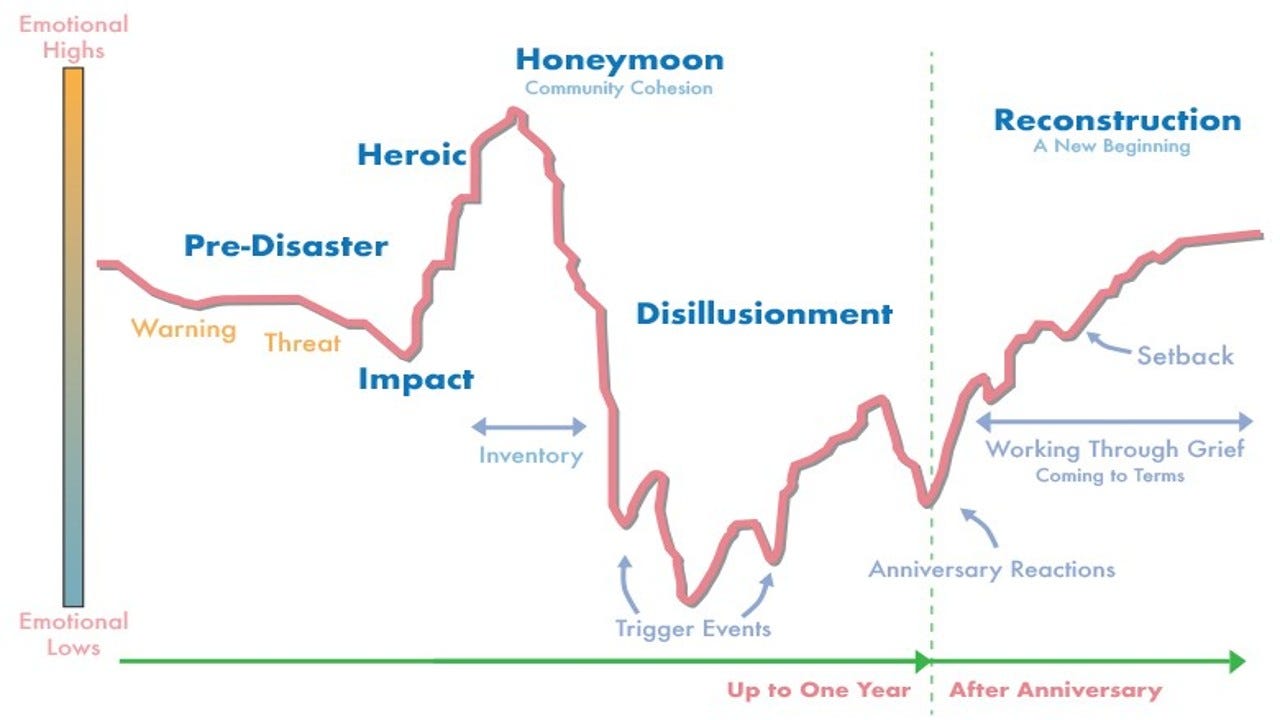
There's a graph produced by the US Department of Homeland Security (DHS) that I keep coming back to. Not because it's reassuring (it isn’t!) but because it's just eerily good at capturing where we are right now.
It comes from the bit of DHS that deals with disaster planning, and sets out the emotional stages that societies go through in wake of disasters. I wrote about it more fully a year and a half ago (here), but the short version goes like this.
A disaster - an earthquake or a hurricane, say - hits. At first, there’s a ‘Honeymoon’ stage. We feel exhilaration as the community pulls together (think of the Covid mutual aid groups that sprang up during the first lockdown). There are extraordinary acts of solidarity and even heroism.
But it doesn’t last. Instead, it gives way to a lengthy period of ‘Disillusionment’. Money worries, relationship stresses, and health concerns all crowd in. We realise how much won’t go back to how it was before disaster struck. It’s like the second Covid lockdown as opposed to the first.
Eventually, though, we find our way through to a ‘Reconstruction’ stage. We work through our grief, recover our sense of agency, and start to rebuild. Finding a new story - of what happened, and how we rose together to the challenge - is central to the process.
But what happens when it’s not a one-off disaster, but one battle after another?
Ever since the 2008 financial crash, the shocks have kept coming, overlapping so that they merge into a single blurry cascade. Before the financial crisis had finished working itself out, the Syrian refugee crisis arrived. Before Brexit had resolved, Covid hit. Before we'd processed Covid, Ukraine. Before Ukraine had settled, the Strait of Hormuz closure. Each new shock arriving before we’d had time to move from Disillusionment to Reconstruction on the last one.
I think we’ve been in the Disillusionment stage for about twenty years now. Money worries. Relationship stresses. Health concerns. A sense that no-one - not the populists, not the centrists, not the experts - has a plan. I call it the Disillusionment Trap.
How we get stuck
What keeps us caught there? One answer comes from disaster sociology, which observes that societies with high levels of fragmentation before the disaster - inequality, deep polarisation - can see those dynamics massively amplified (as in Haiti after the 2010 earthquake).
But to really understand what’s going on, we need to get into the underlying psychology. Because what we’re talking about is the emotional stages of how societies work through disaster, which means this is about what’s happening inside our states of mind as much as what’s going on out there in the state of the world.
More specifically, it’s about all the factors we’ve been looking at on this Substack over the last two years.
There’s the amygdala hijack: how our nervous systems react to a world that constantly takes us into overwhelm and outrage, making us less empathetic, more aggressive, less focused on the common good, and far worse at differentiating what’s real from what’s illusory or a conspiracy theory.
There’s our epidemic of disconnection: the loneliness, the online echo chambers, the sociological sorting into tribes of the like-minded, and how this makes us more self-centred, less able to organise politically, and more vulnerable to extremism.
There’s the grief to grievance pipeline: how experiences of shared loss from decaying town centres to loss of national certainty metastasise into grievance, especially in the hands of skilled political manipulators who excel at turning tragedy into conflict.

And there’s our lack of shared stories - the ‘myth gap’ - and how that vacuum gets filled with narratives that do nothing whatsoever to help us move forward. Stories like ‘we are what we buy’, or that we’re threatened by The Other, or that collapse is inevitable and all we can do is stock up on canned food.
Inner and outer
What all of these dynamics share is that they exist right at the cusp of inner experience and the outer world. They’re about our mental health and the health of our democracies simultaneously. And if it’s the combination of inner and outer that keeps us stuck in the Disillusionment Trap, then the way out of it has to be both/and as well.
Yet what we constantly see instead is attempts to do one without the other.
Inner without outer: we retreat into individual wellbeing, responding to a fundamentally collective crisis with self-care, mindfulness apps, and gong baths. It doesn’t work.

Outer without inner: we end up in activism with no interior roots, leading to toxic organisational cultures, chronic burnout, and relentless othering of opponents because we lack the humility to wonder how they got there.
Psychology without politics. Politics without psychology. Either way, we remain caught in the Disillusionment Trap - because the only way through to Reconstruction requires both.
The ideas we’ve been exploring on this Substack, and at Larger Us for the best part of a decade now, are all about building capacities that live right at this cusp. The ability to steady ourselves in the face of threat. To belong to something larger than our immediate in-group. To bridge divides. To grieve shared loss rather than displace it into grievance. To find new stories about who we are and where we're going. These aren’t just personal virtues. They’re the essential collective infrastructure that allows societies to move through crisis without unravelling.
The religion-shaped hole
But here’s the thing: these capacities have always required institutions to carry and propagate them at scale. And the institutions that historically did this work - above all religions, at their contemplative and prophetic best, but also secular institutions like unions, friendly societies, and mutual improvement societies - are in steep decline.
Not all religion, to be fair. The dogmatic, judgmental, them-and-us kind is thriving amid 21st century turbulence, with all too tangible impact on politics (and rarely for the better).
What’s faring worst is what I think of as the wisdom strand: the kind of religion that has always lived at the cusp of inner and outer in all of the world’s great faiths, and which has historically provided the formation, the community, and the stories that move societies through disillusionment to reconstruction.
Think of how Celtic monasteries kept the flame of civilisation burning through the collapse of the Roman empire - protecting literacy, scholarship, and the contemplative tradition in places like Iona and Lindisfarne from the 5th to the 8th centuries, and then carrying them back into a fragmented Europe.

Think of the Jewish community during the exile to Babylon after 586 BCE, and how it developed the synagogue, the practice of studying Torah without a temple, and the prophetic literature of Jeremiah and Isaiah - forms of contemplative practice that sustained the community through catastrophic disillusionment and eventual recovery.
Think of how Martin Luther King was formed by the Black church’s contemplative tradition - by Thoreau, by Gandhi’s synthesis of Hindu practice and political action, by his friendship with Thich Nhat Hanh - and how the civil rights movement’s training in nonviolence was explicitly a practice of interior formation, of learning to stay centred under the most extreme provocation.
Nor is this limited to the Judaeo-Christian tradition. The wisdom strand is present across all the great faiths: in Sufi Islam, Advaita Vedanta, numerous forms of Buddhism, and Taoism, as well as in Kabbalistic Judaism and contemplative Christianity. And it’s on the back foot across all of them simultaneously, even as the strident, identity-based versions are everywhere ascendant.
It’s no coincidence. The Disillusionment Trap makes strident religion more appealing - offering the sugar rush of certainty, in-group identity, and simple answers - even as it suppresses the wisdom strand, which requires exactly the capacities that disillusionment erodes: patience, humility, sitting with complexity, grieving rather than blaming.
The very conditions that most require the wisdom tradition are the conditions that most suppress it.
That’s the tragedy at the heart of our moment.
But the wisdom tradition isn’t dead. All through history, it has a habit of bubbling back up right when we need it most. I think it’s happening now.
Signs of life
The clearest example is also the largest. As Bill McKibben observed in a superb Guardian piece last month, Pope Leo - an Augustinian formed in the contemplative tradition - is now leading the world’s largest Christian institution in an explicitly contemplative-prophetic direction. The contrast with Pete Hegseth’s shallow proof-texting (to the extent that he managed to quote Pulp Fiction rather than the Bible!) could hardly be more stark.

Something similar is stirring in mainline Protestantism. After Renée Good’s death in Minneapolis, the Episcopal bishop of New Hampshire called on his clergy to get their affairs in order so they could, if necessary, stand between “the powers of this world and the most vulnerable”. Hundreds of clergy descended on Minneapolis as an act of witness; about 100 were arrested at the airport. These are denominations with infrastructure, communities, formation processes. Old institutions finding their contemplative-prophetic roots anew.
There are new institutional forms emerging too. The Nearness, co-founded by my friend Casper Ter Kuile, sets out to explore the “spiritual infrastructure of the future” - not as an academic exercise, but as a living experiment in new forms of spiritual community. (I’ve been working in spare moments on an idea called Restorers, which would bring people together in small groups to do a mixture of contemplative, relational, and political work. Some very early stage thinking is here if you’re curious - feedback and expressions of interest warmly welcomed.)
How does this spread?
What I’m most interested in is how initiatives like these reach launch velocity - not through central coordination, but through a bottom-up process of self-seeding.
The story of Alcoholics Anonymous is so instructive here. AA spread across the world not because someone ran a campaign, but because the model was simple and reproducible, and because it met a need that no-one else was addressing. No headquarters, no marketing budget, just a practice that worked, passed from one person to the next.
It doesn't have to be religious, either. The Radical Love campaign in Istanbul in 2019, which defeated Erdoğan's populist authoritarianism by training activists to “ignore Erdoğan, but love those who love him”, was built on exactly the same integration of inner and outer, without any explicit religious framing. “We saw that we cannot change Erdoğan, so we fight by changing ourselves,” as the playbook put it. It worked.
I think about the self-seeding dynamic of AA when I think of the people in Leeds I wrote about last autumn, who’ve been showing up to weekly protests outside a hotel housing asylum seekers with cake and curious conversations: talking to everyone, protestors and counter-protestors alike, making the point through their actions that everyone has inherent value. Similar work has been happening at Hodge Hill in Birmingham. Both are beautiful. Yet neither has spread like yeast.
Why not? I’m genuinely curious. Is it the model? The stories? The absence of the kind of simple, reproducible format that made AA transmissible?
I don’t have a complete answer. But I do know this: reaching tipping points on any of these initiatives ultimately comes down to people joining in. The wisdom tradition has always spread this way - not top-down, but person to person, community to community. One small group at a time.
Links I liked
This piece by Mike Chitty is the single best thing I’ve read in response to the most recent Tommy Robinson march in London.
Rutger Bregman says that there are 10 signs of emerging fascism - and that America is displaying all of them right now.
Liz Bucar continues to write incredibly thoughtful pieces on the state of ‘spiritual but not religious’ practice and its shortcomings, and this piece of hers picking over the latest Pew Center polling data is terrific.
As someone who enjoys the use of psychology in politics this was a great read. I'd often talk about society being in it's teenage years in relation to the crises we face. Aware of things they could change for their benefit, but not fully mature enough yet to do it. That's what it feels like sometimes when we talk about climate or our social issues and you've articulated it so much better than I ever could - great piece.
Brilliant Alex!