

Not an oil shock. An everything shock.
The UK's former resilience tsar on what's coming and what to do about it

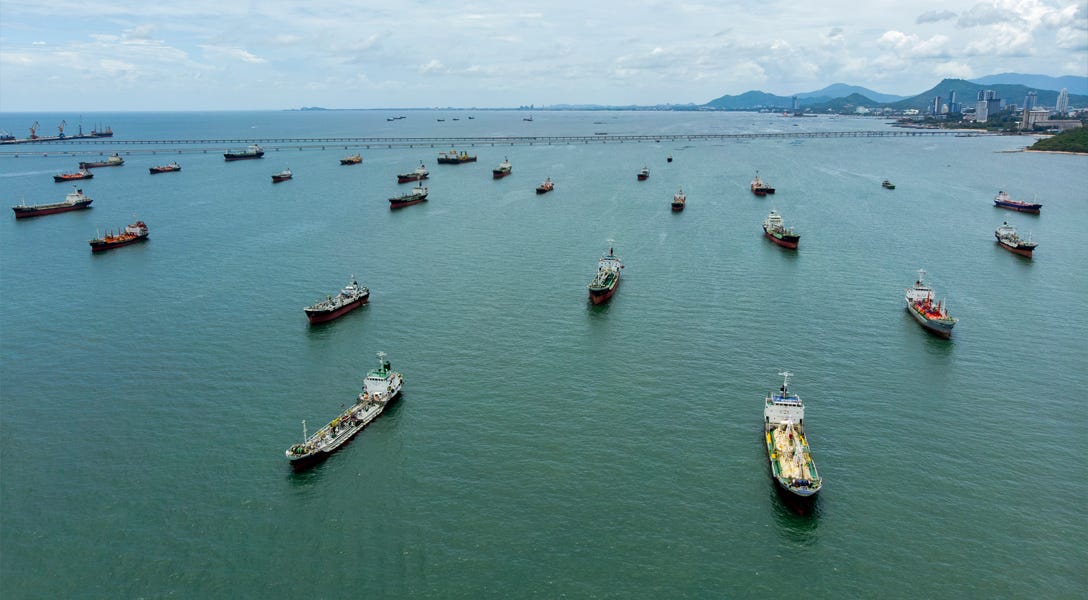
The Strait of Hormuz has been closed for nearly three months now. So far, most people haven’t noticed much difference other than paying a bit more for their petrol. Financial and commodity markets are calm - weirdly upbeat, some might say.
But all that might be about to change, because up till now the impact has been cushioned as we’ve run down reserves, and as cargoes that left the Gulf before the war continued to reach their destinations.
Is this going to be another round of the cost of living crisis that kicked in when Russia invaded Ukraine? Will there be actual shortages like at the beginning of Covid? Will there be consequences we haven’t even thought of yet?
These kinds of questions are right up our street on the Good Apocalypse Guide, and I couldn’t think of anyone better to explore them with than Bruce Mann.
I first met Bruce over twenty years ago when I was a special adviser in the government, and Bruce was the government’s Crisis Director in COBR and head of the Cabinet Office’s Civil Contingencies Secretariat. That means he was the person responsible for emergency readiness and response for the really big things that can go wrong: terrorism, natural disasters, pandemics, nuclear accidents.
During that first meeting, I was blown away by his ability to anticipate consequences of consequences and cascading failures far before they actually happened. I can still remember him observing: “That heat wave in Poland is going to take down Spain’s power grid next week, but they haven’t realised it yet” - and then walking me through how that was going to happen, his eyes twinkling as he did so.
Bruce now provides support on resilience and emergency planning to governments all over the world, and was leader of the Independent Review of UK Civil Protection Arrangements on behalf of the National Preparedness Commission. He was also an expert witness and adviser to the UK Covid-19 inquiry. Here’s an edited transcript of our conversation (if you’d rather listen to the full podcast, you can find it here).
Alex Evans
Bruce, you spent years in the Civil Contingencies Secretariat gaming out scenarios exactly like this one. When the Strait actually closed, with traffic dropping from one hundred and thirty ships a day to essentially zero — was it a “this is the one we always worried about” moment? Or did the reality still manage to surprise you?
Bruce Mann
Absolutely no surprise at all. I first started thinking about this over thirty years ago when I was in the Ministry of Defence. After the end of the Cold War, we needed to work through what the armed forces were going to be doing in future. One approach was to look at where the flash points might be — where the vulnerabilities and choke points were — so that even if you couldn’t predict events, you could at least identify where future shocks might hit. We identified closure of the Strait at that time. It had happened before in the tanker wars in the eighties. And now it’s happened again.
To bring it right up to date: after the US bombing in June last year, a whole range of governments said it’s going to happen again and we’d better start preparing. So I’ve been working hard in support of some governments on that for the best part of a year. So no surprise either historically or recently.
Alex Evans
Walk us through what you expect to happen over the next two or three months. At the moment people are still broadly going about their lives; the shelves aren’t empty. What’s the gap between the disruption that’s already locked in and what ordinary people can actually feel right now?
Bruce Mann
There’s a range of moving parts, and clearly an awful lot depends on how long the Strait stays closed. But I think we’re now going to see effects extending into the autumn and winter — that’s baked in. Let me think about the likely impacts at three levels.
The first is the direct effects on supplies of goods and services. Hydrocarbon products — everybody knows about petrol, diesel, kerosene. But there’s also an enormous amount which is invisible: synthetic plastics used in packaging and electronics, synthetic rubber for tyres and footwear, solvents, cleaners, lubricants, motor oils, even cosmetics. The Gulf producers supply nearly three quarters of world trade in hydrocarbon derivatives. Then there are chemical products, medicines and medical products — the NHS in England has already started stockpiling, very sensibly — jet fuel, metals including aluminium and steel, which go into car body panels, aircraft fuselages, beverage cans, electrical grid infrastructure.
The second level is the economic impacts — inflation, employment, interest rates and growth — on which there’s some really good analysis coming out of the FT, The Economist, the World Bank, the G7.
The third level, the one I lose sleep over, is the broader social and political effects. What does this mean for people’s reduced sense of economic wellbeing? How does that translate into social stability — especially if we start to see hoarding? If these effects aren’t managed well, what is the impact on trust in political and economic governance? That provides a fertile field for those with mischief in mind.
Alex Evans
This is not just an oil shock then — it’s an everything shock.
Bruce Mann
Absolutely. What starts as an oil shock moves into a manufacturing shock, moves into a food shock with fertilisers and so on, coupled with an economic shock, all of which may have social consequences. That’s the nature of cascading and compounding consequences. If you only look at these things in their own narrow terms and don’t see the totality and the way they interconnect, your response and your planning will be suboptimal.
Alex Evans
On that third level — the one you lose sleep over — how much can governments really do? It feels like in multiple countries, governments are already on the back foot in the face of growing support for populism and extremism. Is that why you lose sleep over it, or do you think there’s planning governments can do to invest ahead of time in managing the risk of social instability?
Bruce Mann
To give credit to governments, most are doing good stuff. You can see governments acting on fuel supply, on food, on fertiliser. The NHS is stockpiling medicines. G7 officials are meeting.
The hurdle I’d like to see the UK government jump is levelling up with the public. East Asia is doing it. Australia is. The UK government is a bit behind — still a bit of the Big Mother syndrome, where the government will look after you and it’s all going to be okay. That might work if the closure isn’t extended. But if it is, that approach is going to run out of road really quite quickly.
Alex Evans
Do you have a best case, worst case, and middle case sense of the scenarios?
Bruce Mann
At one end, there’s some kind of peace agreement in the relatively near future. We’d still see impacts extending into autumn and winter, but I’d worry less about the economic and social effects.
Somewhere in the middle is a scenario where the bombing stops but shipping flows through the Gulf remain constrained — not back to the one hundred and thirty vessels a day. That would affect different countries very differently, particularly East Asia which is heavily reliant on fuel through the Gulf.
At the other end is continuing closure all the way through into the autumn, where I think we’d see not only more cascades — second, third, fourth order — but they’d cumulate on each other. And once you’ve got those, remembering that the British people have been feeling economic effects ever since the great financial crash — this is nearly twenty years now — this is yet another damn thing. It’s in that space that I begin to worry not only for the British people, but about the opportunity for mischief based in simplistic solutions pushed for political or other ends.
Alex Evans
That makes me think of the graph that shows the emotional stages societies go through in the wake of a big disaster: the initial Honeymoon stage, then a long Disillusionment stage, and then eventually the Reconstruction stage. I wonder if we’ve been stuck in that Disillusionment stage for a very long time, because it’s not just been one disaster but one after another. Before the financial crisis in 2008 finished working itself out, the Syrian refugee crisis arrived. Before Brexit resolved, Covid hit. Before we processed Covid, we had Ukraine. And now before Ukraine has settled, we’ve got the Strait of Hormuz closure. Each shock arriving before we’ve had time to get back on our feet from the previous one.
Bruce Mann
I think that graph is very much a sudden shock type graph — you get heroism, everything is wonderful in the first few days, then something goes wrong operationally or politically and you go into the disillusionment trough, then you come out on the recovery side. I have reservations about it — you only get disillusionment if something has gone wrong, either operationally or politically, and there have been plenty of operations where things have gone right and people have got on with their lives.
My bigger point is that we need to look at this through a completely different lens - as other governments do. I wonder whether we lived through a golden period from the end of the Cold War until the great financial crisis — no longer under an existential security threat, an underlying presumption that most shocks would be relatively limited, responded to effectively by public sector responders.
That world has changed. We’ve moved into a more globally interconnected society and economy. Everything is actually connected to everything else. If on top of food security issues from the Strait closure we get an El Niño weather pattern, all of a sudden that interconnectedness will be more obvious and felt harder. I wonder if we in the UK have got that inside our heads. All of our systems and instincts are based on a world that no longer exists. That’s the shift we need to make in government to build the resilience of our societies.
Alex Evans
You mentioned the Big Mother scenario — where government tries to do everything itself and elbows everybody else out of the way. David Steven and I contrasted that in our Long Crisis Scenarios with a much more distributed scenario called Winning Ugly, where everyone is empowered to be part of the solution. What does distributed resilience look like in practice, facing a months-long Strait closure with all its cascading consequences?
Bruce Mann
It’s a live debate. People in the UK have started to speak rather more loudly about so-called whole-of-society resilience. I’m not a great fan of the name “Winning Ugly” — I think this distributed resilience, the engagement of citizens and communities and businesses, is actually a beautiful thing.
There is a really good debate going on inside the UK about this. The government said in its Strategic Defence Review that we need a national conversation on the threats we face, calling for unity of effort across society. But there has been almost complete silence since then. As Lord Toby Harris of the National Preparedness Commission has said, the conversation has so far largely been conducted in whispers.
What does it take? First, leadership with moral courage. It takes courage to stand up and start talking about difficult things. Second, what the Americans call followership — public trust and social capital. Third, much better public communication and information sharing. Fourth, celebrating and promoting success — there’s actually quite a lot of good stuff going on involving communities and businesses in parts of the UK. And fifth, political maturity — none of this need be an issue of political point scoring.
Alex Evans
You referred to risks that governments aren’t really talking about with the public in the way you’d wish. What are those dangers and vulnerabilities, and how can government communicate about them in a way that helps people prepare without triggering panic?
Bruce Mann
The government’s actually already doing some of this. “See It, Say It, Sorted” — every time you take a train, you hear that message. There’s a drumbeat about cyber security. The most recent UK National Risk Register has some quite difficult things in there — inadvertent use of a nuclear weapon, conflict in Europe. And there’s good advice on the government’s “Prepare” website. But that’s not advertised, so I suspect very few people go to it, and it isn’t promoted or used in its public communications by the government.
What a whole range of countries are facing is cyber on a pretty sustained scale, plus hostile reconnaissance and occasional physical acts of sabotage — the DHL parcel bomb, damage to undersea cables. Plus deliberate disinformation campaigns — a government minister tweeted just a week ago about a deliberate disinformation video campaign coming out of Sri Lanka, aiming to stir up social tension and exacerbate divisions by playing on race and otherness.
We see little bits of this kaleidoscope occasionally illuminate by Ministers or senior officers and officials. What nobody is yet doing is joining it up and saying: when you do join it up, what we’re facing is much more sustained and coordinated than it appears. And if the bad guys turn up the dial, it gets really quite serious really quite quickly.
Alex Evans
If a switched-on, non-catastrophising person came to you right now and said “what should I actually do to prepare?” — what would you say? What is useful preparation versus just anxiety with a to-do list?
Bruce Mann
[I should] declare an interest — I’m on the advisory board of a community interest company working on exactly this space on household preparedness.
Four things. First — boring, I know, but just sit down and think about it. And when you think about it, don’t just think about what might happen in your neighbourhood in terms of cause. The lights going off could be a telegraph pole falling over in a big storm, or a hostile state mounting a cyber attack. The cause is less important than the effect. Think about what you’d actually do.
Second, do think about the sensible practical stuff. If the power went off for three to seven days — and the government website has a scenario where national power loss might take up to seven days to restore — what would you do about food? How would you keep your phone charged? What about people who do dialysis at home?
Third, think about family and community. How are you going to help each other? You don’t have to do anything fancy — just have each other’s phone numbers. Know who’s got the chainsaws, who’s got the generators, where you’d go if you were flooded. Really simple stuff.
And fourth, if you’re a business: think about the practical stuff about how you’d keep going, and how as a business you might support your community. We saw in Covid some of the big supermarkets reaching out, saying “we’ve got the trucks, we’ve got the delivery vans — can we help?” Government wasn’t great at picking that up at the time.
Alex Evans
You’ve talked throughout this conversation about how global interconnectedness has created vulnerabilities as well as opportunities. Do you feel that globalisation went too far, and that at this point a bit more national or local self-sufficiency would be desirable?
Bruce Mann
I need to unpack that. At the level of interstate collaboration, absolutely not — the geopolitical stability that brought has put us in a much better place than we were in 1945. But the flip side is that there are parts of it where we collectively got complacent. We assumed it would carry on, that the golden period from 1945 to maybe 2010 was the normal run of events. People — boards as much as governments — were too ready to take the upside on things like just-in-time supply chains, or the assumption that large parts of your electricity imports could come from a country that would always stay stable and friendly. That bred complacency. People didn’t pause and say: “Talk to me about the downside. Where am I building in vulnerability? How do I detect if things are turning sour in time to react?”
Globalisation, net, is a huge benefit. But inside it, complacency systemically is something we’re now rapidly having to unwind.
Alex Evans
Last question. One of the ideas I write about is that pronounced moments of turbulence can lead to breakdown, but they can also lead to breakthrough. Is that something you recognise in your work? And what might building back better look like from the current shock?
Bruce Mann
Oh yes, absolutely. The people in this trade — we think about gloomy things, but most of us are optimists. We believe you can bounce back better. Otherwise you wouldn’t do the job.
Aircraft hijackings in the seventies and eighties were a real and recurring threat. After 9/11, as a society we dealt with that risk. We built different systems, processes, expectations, cultures. We don’t see aircraft-based terrorism anymore.
Covid-19 was an absolute tragedy, but some of the fundamentals to do the next pandemic better are now in place — the science underlying the speed with which we developed a vaccine, the learning on transmission, the WHO pandemic agreement. In many cases, sometimes in a way that’s not recognised, we do come out of these things with learning and adaptation.
Alex Evans
And if you’re thinking three to five years ahead, imagining ways we could build back better off the back of the current crisis — what would be high on your shopping list?
Bruce Mann
How many wishes are you allowing me?
Alex Evans
Three.
Bruce Mann
First: for the UK government to start looking at this as a systemic problem. It’s no longer about single crises or a bunch of blue-light responders. We have to think about systemic societal resilience — supply chains, manufacturing, energy, food. A whole range of different ways of doing business would flow from that.
Second: leadership. Courageous, mature political leaders and civil service leaders are going to have to change what they think they do — both in terms of communication and in terms of recognition of their responsibilities for the safety and security of people. That’s a big shift.
And third — back to Big Beautiful — we have got to have that national conversation. Sensible, mature, maybe incrementally introduced: welcoming citizen engagement, household preparedness. It’s not that scary. I could talk about what’s being done in the Gulf, in East Asia, in Australia. If we could get into that place — systemic thinking about resilience, courageous leadership, and citizen engagement — that would be the transformation we called for in our 2022 review for the world we thought we would face. I’m afraid we’re in that world now, and we really do need to get on with it.
I was interested to read this after the build up, but then so disappointed with the platitudes.
Where is the response to the coming food shortages next Autumn when the crops come in 30% below normal? Where does Britain import 60% of its food from, when other countries are stopping exports because they need it for their own populations?
And where will Britain import diesel from, when America stops selling diesel for export as it runs short too? So how will farmers harvest without enough diesel? Or process and dry crops without gas?
No serious questions, no deeper analysis. It did exactly what Britain always tries to do - "Don't worry, we'll muddle through somehow!"
This whole article is based on a false assumption; that federal government will continue. As an alternative, consider for a moment that shit rolls downhill. So does power. As the federal government falls apart, as is happening in the UK right now, more and more power will flow downhill to local council governments and to local groups that can see it and act on it. What the active preparedness community needs to do is develop ways to access the power that comes their way AND even to seize power when they can. Bromides like this article aren't worth much. To be blunt and coarse about it, "Good Apocalypse my ass! It will not be fun at all. Better get used to ameliorating suffering through wise intervention."