

How do you solve a problem like collective trauma?
The front line in our apocalyptic times

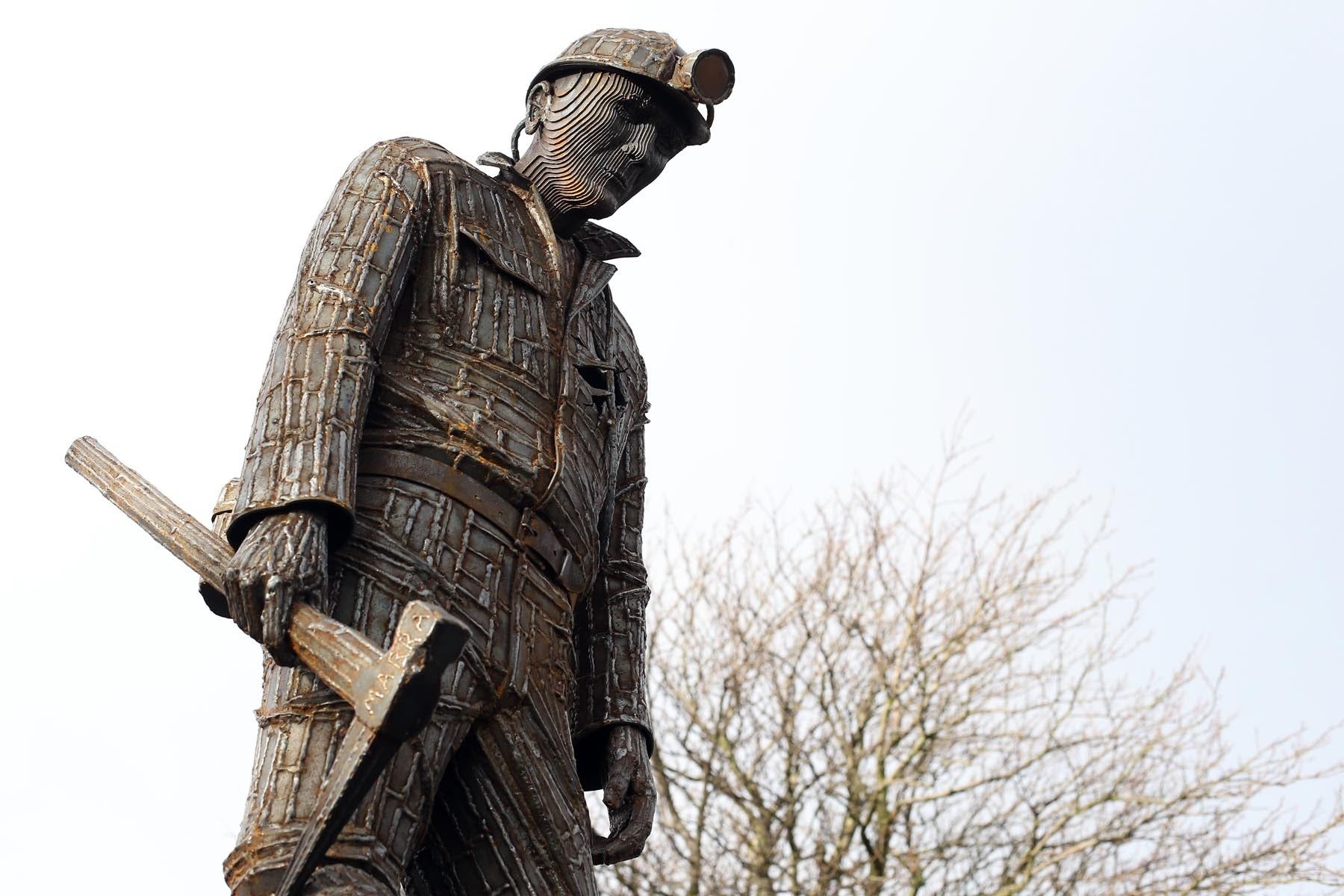
I was up in Horden in County Durham the other week. Horden was once home to a thriving colliery, but the mine closed in 1986 — and the community is still grappling with the effects today. If you walk through Horden’s beautifully kept community park, you’ll notice this statue of a coal miner. Look closer, and you notice something else. His heart has been torn out.
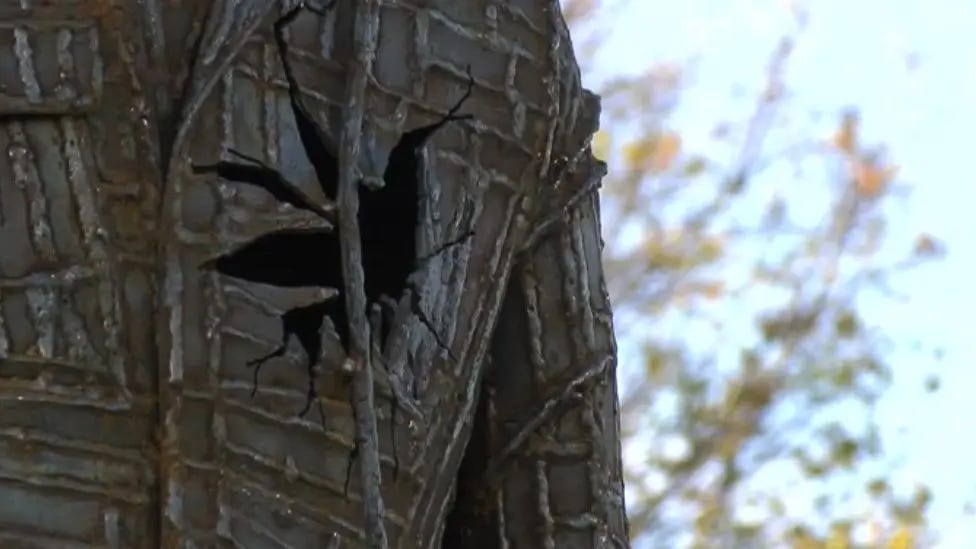
There are towns near me in Yorkshire that have had their hearts torn out, too: places like Bradford, Keighley, Batley, and Huddersfield. All of them used to be thriving mill towns, exporting textiles all over the world, but lost their industries at around the same time as Horden’s mine shut down, leaving similarly deep scars.
You can find these dynamics at the level of whole nations, as well. Russia experienced it during and after the collapse of the Soviet Union, for instance, as filmmaker Adam Curtis explores in his documentary Traumazone.
In all these cases, the impacts extended far beyond just material standards of living. They challenged the community’s sense of safety, its belief in the future, its very idea of itself.
And that’s before we think of all the examples of what can happen when communities are on the receiving end of ‘othering’ — when another group sees them as inherently inferior or threatening, and targets them because of it.
Think of the mass enslavement of millions of Africans and their descendants, or apartheid in South Africa, or ethnic cleansing in the former Yugoslavia, or persecution of the Uighurs in Xinjiang, or how people of colour in the US are being rounded up into unmarked vans by masked men.
Think of genocides. Of how Jews were targeted in the Holocaust because they were Jewish. Just like Tutsis were targeted in the Rwandan genocide in 1994 because of who they were, or Ukrainians in the Holodomor in 1933-4, or Armenians in the Turkish genocide in 1915-17, or Palestinians in Gaza right now.
What we’re talking about, in all these cases, is collective trauma.
The effects of collective trauma
Psychologists talk about two different kinds of trauma.
In the strict sense, trauma is what happens when we experience or witness a catastrophic event (death, injury, sexual violence), or it happens to someone we love. The effects of PTSD can linger for years — lifetimes, even — for instance as flashbacks, intrusive thoughts or images, nightmares, or intense distress at reminders of the event.
Then there’s ‘complex’ trauma: the kind that results not from a single terrible event, but instead from prolonged or repeated exposure to distressing events, like abuse, neglect, or living in poverty. This can lead to additional symptoms, like feelings of worthlessness or guilt; problems controlling emotions; or relationship problems like having trouble keeping friends and partners.
In both cases, the key theme is feeling unsafe. Psychiatrist Bessel van der Kolk emphasises how trauma can cause people to get stuck in a fight-flight-freeze state with a “hyperactive alarm system” and a “constant sense of danger”. Collective trauma is like that, but at bigger scale.
What we’re talking about here is more than just trauma that affects lots of people. Instead, it’s what happens when trauma affects a community or society as a collective. A community that may have felt high levels of self-worth, agency, and resilience may instead find itself contending with feelings of shame, helplessness, and hopelessness — which can in turn lead to social problems like alcoholism, addiction, domestic violence, or suicide.
The consequences can show up politically, too, above all when traumatic experiences become central to group identity. I’ve written before about Vamik Volkan, the go-to expert on this area, and his example of how Serbia’s defeat at the Battle of Kosovo in 1389 remains central to Serbian nationalism today. In such cases, it’s all too easy for manipulative leaders to usher people along a ‘grief to grievance pipeline’ — which, in the case of Serbian nationalism, played a key role in igniting World War 1 in 1914, or triggering a genocide in Bosnia in the 1990s.
And just as with individual trauma, collective trauma can be inherited — literally passed down from one generation to another, not just through behaviour, but epigenetically, through changes in which parts of the DNA code are activated and expressed.
Even now, children and grandchildren of Holocaust survivors, or of people who lived through famine in the Netherlands in 1944-45, are more likely to suffer from PTSD than the population as a whole. Male descendants of Union soldiers who survived appalling conditions in Confederate prisoner of war camps in the US civil war, meanwhile, have higher death rates.
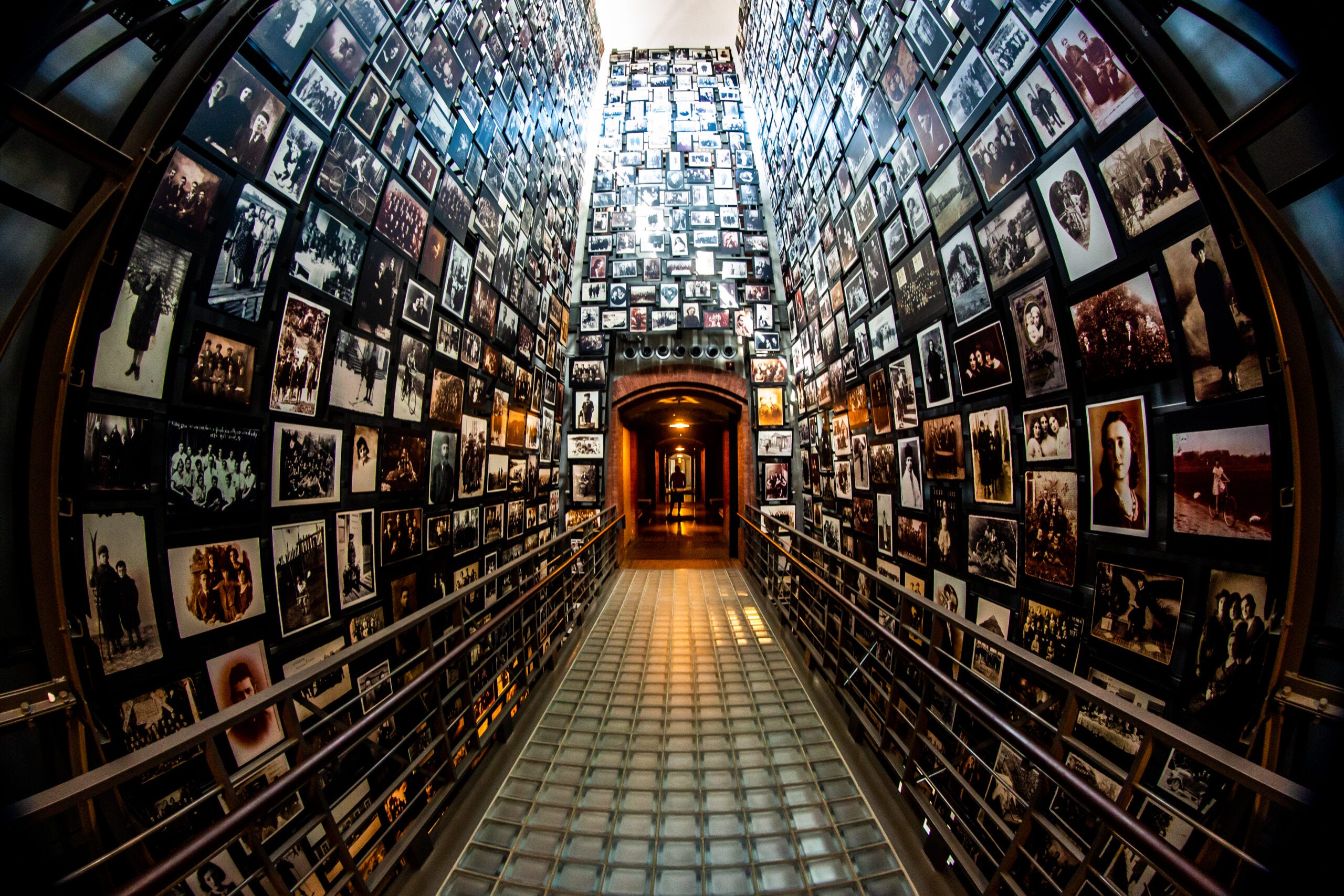
You have to wonder: just how far do the consequences of collective trauma extend, as they ripple outwards from survivors to the people around them, the communities and societies they live in, and the generations that follow them? Because as we look around us at the times we’re living through, it can feel like it’s everywhere.
In the third of kids in the UK growing up in poverty. In what the pandemic did to us as we went through one lockdown after another. In so-called ‘culture wars’ over race, or gender, or sexuality. In Trump’s ‘Make America Great Again’ narrative. In how the far right is on the march here in the UK too. In Putin’s invasion of Ukraine. In Xi Jinping’s expansionist foreign policy towards Taiwan. In warzones like Sudan, or Yemen, or Gaza.
As we slide deeper into our apocalyptic polycrisis, my hunch is that the path towards a breakthrough rather than breakdown future runs directly through recognising, tending to, and ultimately healing these trauma dynamics.
But what would that even look like?
Healing collective trauma
Psychology has some answers — for individuals, at least.
There’s ‘psychological first aid’. Cognitive behaviour therapy. Eye movement desensitisation and reprocessing (EMDR). All have strong evidence for their effectiveness. And when people do the work of healing from trauma, they’re also helping to break the chain of trauma being passed down generations (as psychologist Tabitha Mpamira-Kaguri puts it, “trauma not transformed is trauma transferred”).
But when we turn to collective trauma, psychology has less to offer. Perhaps it’s unsurprising, given that psychology is primarily concerned with treating individuals whereas “collective trauma can only be treated collectively”, as Thomas Hübl, an expert in this field, puts it.
So what do we know about how to treat collective trauma? I’ve been reading everything I can find about this, and a few themes keep showing up.
Protecting. It’s hard, perhaps impossible, for communities to heal if the thing that caused the trauma is still happening. In a war, say, the shooting has to stop before recovery can start. (Which makes me wonder: what about when the cause isn’t something that’s going to just stop — like poverty?)
Acknowledging. Recognising what’s happened, and validating the impact on those affected, is essential to the healing process. Denying, avoiding, or suppressing the experience only makes things worse. It’s like the ‘truth’ bit in South Africa’s Truth and Reconciliation Commission: the community has to be willing to face the past.
Connecting. Community, belonging, and care really matter. When we hurt ourselves as kids, it’s the love of a parent or caregiver that helps us to feel better. In communities, we play that role for each other; it’s the ‘tend-and-befriend’ stress response in action. In particular, deep listening to each other, in a way that makes us feel heard, seems to be crucial.
Grieving. Mourning is vital to working through experiences of loss — and when the loss is collective, the grieving needs to be too. Often, this can take the form of ritual, like the one in Glasgow that my colleague Claire wrote about here or the ‘Despair Ritual’ organised after the Three Mile Island nuclear accident in the US in 1979. Memorialisation is important, too, like the 1987 AIDS Memorial Quilt (the “largest community art project in history”) or the National Covid Memorial Wall here in the UK.
Telling stories. In ‘narrative exposure therapy’, a survivor tells and retells their story to a therapist, so that a narrative of hurt and vulnerability gradually becomes one of strength and resilience instead. There’s a collective equivalent, too: in the wake of disasters, finding new stories — of what happened and why, of what the future might look like, of collective identity — can be a critical part of how communities recover.
Rebuilding. Finally, there’s the work of reconstruction, when communities begin to move forward, not just in the sense of rebuilding what’s been damaged (infrastructure, homes, economies), but in the emotional sense of recovering a collective sense of agency.
Recovery doesn’t mean everything going back to how it was before. Communities come back changed by trauma — but sometimes, having discovered new capacities in themselves. Psychologists talk about the potential for ‘post-traumatic growth’ in individuals who’ve experienced trauma, and there are collective versions of this, too: deeper relationships and trust, greater collaboration and mutual aid, shared resolve around rebuilding, a stronger sense of solidarity or shared identity. (My brother Jules and I wrote a report for Wellcome in 2020 that explored exactly this in the pandemic.)
When one group has harmed another
What about how communities heal from trauma when another community has deliberately harmed them? Here too, there are some useful principles to draw on. One such set is the four pillars of transitional justice, an approach that seeks to help societies move forward after mass atrocities, which are:
Truth — establishing and acknowledging what’s happened, with all parties (above all victims and their families) able to make their voices heard
Justice — identifying and prosecuting perpetrators, for reasons of both prevention and reparation
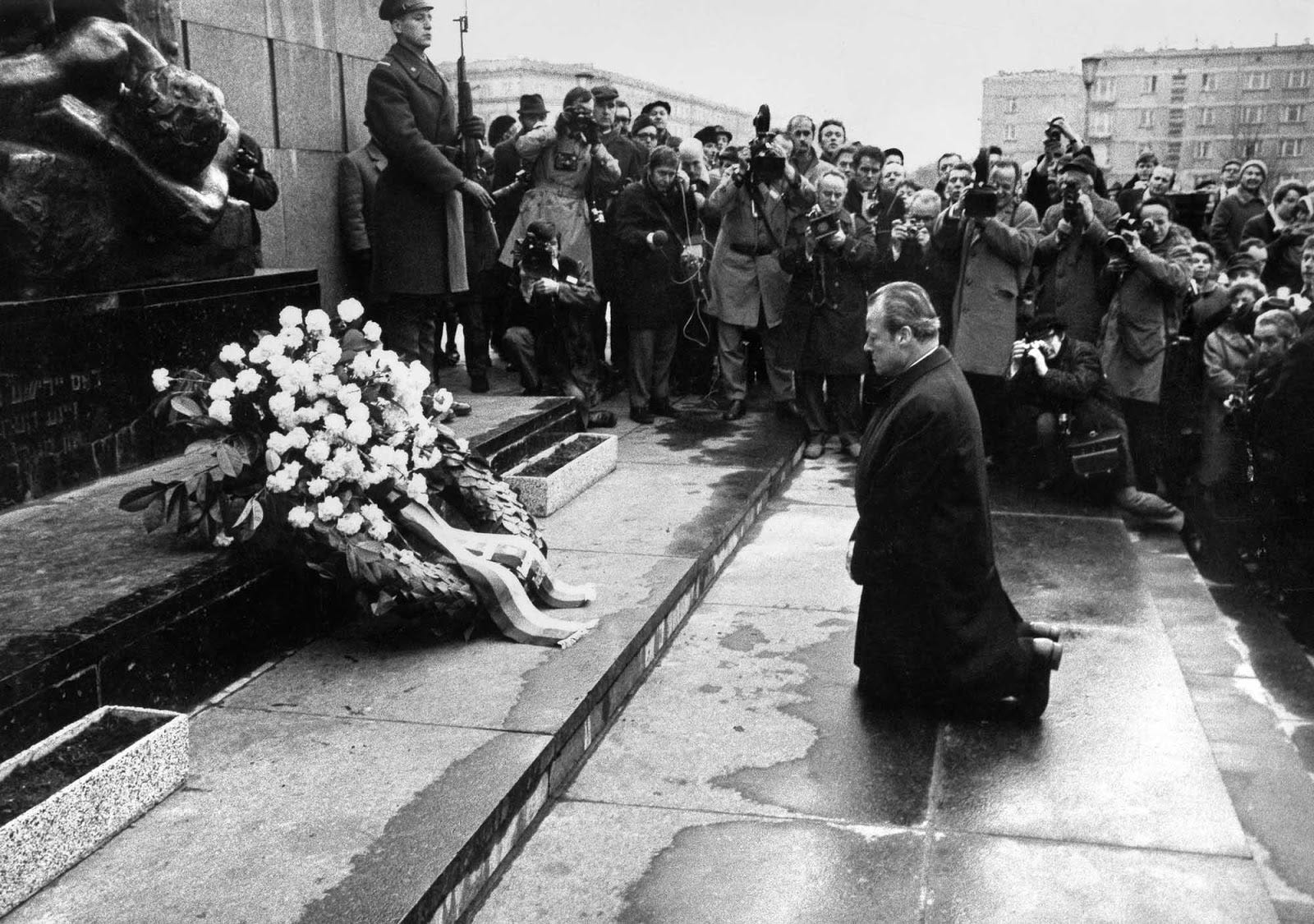
Reparation — not just economic compensation, but also symbolic gestures such as public apologies and the building of memorials, together with measures aiming at improving the lives of victims and their families
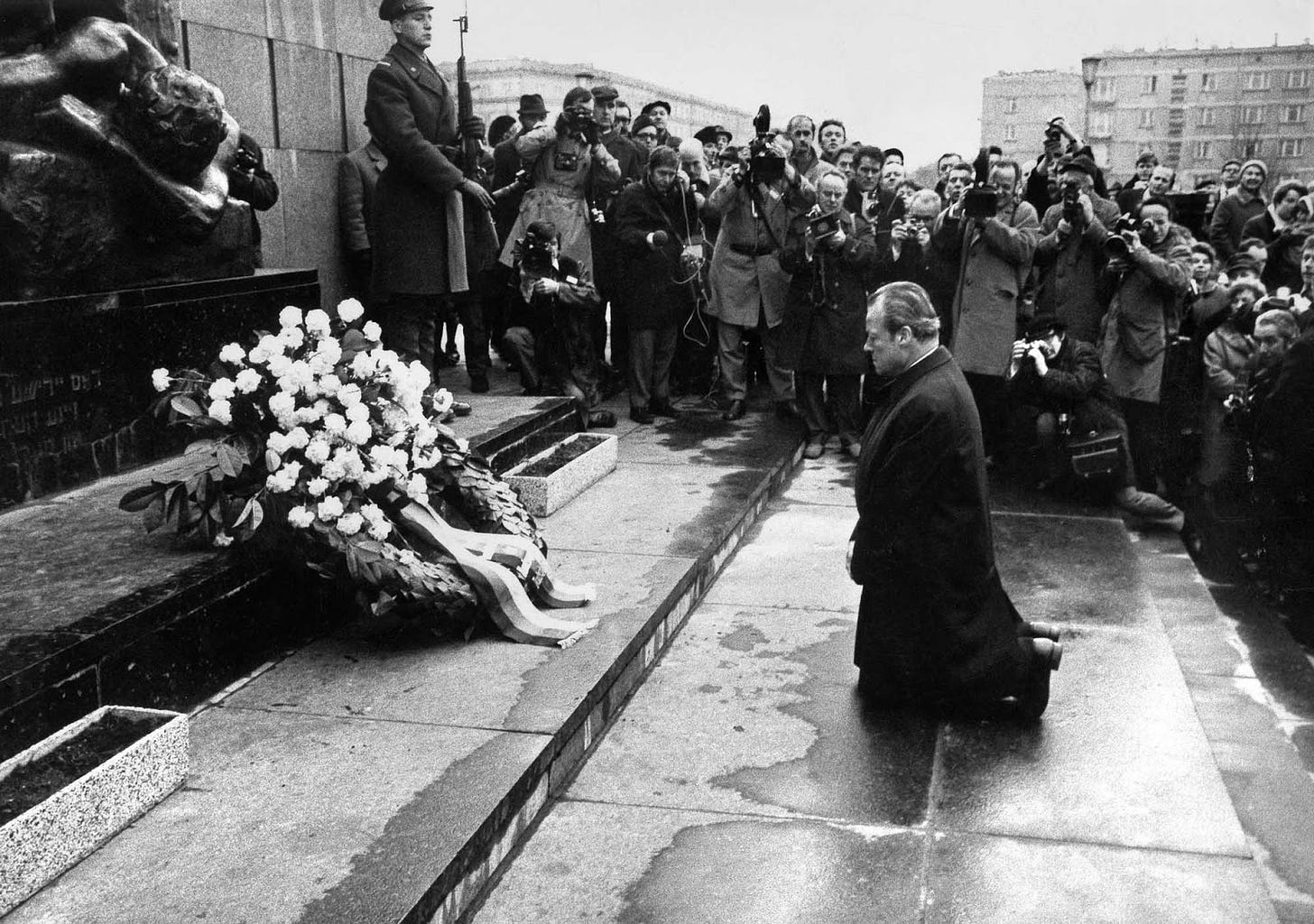
German Chancellor Willy Brandt kneels at the Warsaw Ghetto memorial in 1970 Guarantees of non-recurrence — learning from past mistakes, including through institutional reforms that prevent the trauma from happening again and that reinforce accountability, transparency, and fairness
There’s also restorative justice, where victims and perpetrators come together to discuss the harm caused and what the offender can do to repair it. There are caveats: it has to be voluntary for both sides, and is a complement to formal justice, not a substitute for it. But in the right circumstances, it can be transformative — as for instance with how Jo Berry, the daughter of an MP killed by an IRA bomb in 1984, met and ultimately forgave Patrick Magee, the man who planted the bomb.
The problem with both transitional and restorative justice, though, is that it’s not clear what happens when perpetrators don’t want to see the ways in which they’ve done harm, and there’s no higher authority that can hold them to account. Look, for instance, at how Britain struggles to face up to the harms we perpetrated under colonialism. We celebrate our role in the emancipation movement that ended slavery — but often overlook our role in causing slavery in the first place. We commemorate our soldiers’ sacrifice in the World Wars — but tend to ignore the harms they committed in (for example) India, Malaysia, Kenya, or Afghanistan. Even just mentioning such cases can trigger furious mini-culture wars.
This is a classic case of Carl Jung’s concept of the Shadow in psychology: the idea that there are aspects of ourselves that we are unwilling to face up to, and repress out of our conscious awareness. Often, we end up projecting the failings that we refuse to see in ourselves onto other people instead. It’s a dynamic that can be especially powerful when you have two groups that have both harmed each other, where each side blames the other for everything, and refuses to take any responsibility for how it too has helped to create and reinforce the mutual trauma.
And then you have yet another complicating factor: the fact that groups that inflict trauma on others have often experienced trauma themselves. I caught up last week with Corinne Fowler, the historian who led the National Trust’s work to unpack the colonial histories of its properties, and she reminded me of how colonialism overseas was tangled up in the collective trauma of enclosure, land clearances, and dispossession at home. Or think of how Britain’s tiny, unrepresentative ruling class is dominated by men who were sent away from their families to boarding schools where bullying and abuse was rife, often at painfully young ages.
To be clear, no amount of trauma excuses the actions of people that perpetrate harm, and the glib phrase that ‘hurt people, hurt people’ overlooks the fact that the vast majority of people who’ve experienced trauma do not actively harm others (and indeed that the pain they suffered often leads them to go on to help others rather than hurt them). But the fact that some people — or communities, or nations — do act out their pain on others underlines the fact that trauma wounds in our body politic or our collective psychology affect all of us, and all of us have a stake in healing them.
Where does this leave us
So where does all this leave us? Four thoughts in closing.
First, collective trauma is a big deal. You can see it playing out in so many contexts, across so many issues, in so many places, with such far-reaching effects. Yet we don’t talk or think about it anywhere near enough — in psychology, in politics, in our conversations, in the news. That needs to change if we want to change our future to a brighter one than the one we’re headed towards right now.
Second, it’s not clear whose job it is to help us work it through. If you’ve suffered trauma as an individual, you go and see a psychiatrist or therapist. But who are we supposed to go and see about collective trauma? (I feel like people who work on peacebuilding have a lot to teach us — bringing their expertise to a much wider audience feels like an urgent job.)
Third, there’s the difficult, challenging fact that perpetrators need healing too in order for us all to be able to move forward. I’m reminded of James Baldwin’s description, in a 1962 letter to his newborn nephew, of white supremacists as “your brothers, your lost younger brothers, and if the word ‘integration’ means anything, this is what it means, that we with love shall force our brothers to see themselves as they are, to cease fleeing from reality and begin to change it, for this is your home, my friend”.
Fourth and finally, this is deep work. A line that stayed with me from Thomas Hübl’s book on collective trauma is his observation that Native Americans see the suffering they experienced from European colonisation, that has been passed down the generations since, as “spiritual injury, soul sickness, soul wounding, and ancestral hurt”. Healing these injuries, sicknesses, wounds and hurts is liminal work, that feels like it belongs in the kind of deep time that’s measured in generations and centuries.
But it’s also an urgent task — one that we need to get to work on right now.
New on the Podcast
Just out on the Good Apocalypse Podcast: Miriam Juan-Torres González on whether bridge-building can save democracy.
Miriam is head of research at the Othering and Belonging Institute’s Democracy and Belonging Forum, and in her previous role as a senior researcher at More In Common co-wrote two massively influential reports — Hidden Tribes on the US and Britain’s Choice on the UK — which mapped political opinion in those countries into well-known segments like Progressive Activists and Backbone Conservatives.
We had a great chat about the evolution of political polarisation since 2016, the rise of authoritarian populism, and strategies for building bridges and defending democracy in turbulent times, with loads of insights from Miriam’s research plus some brilliant real-world examples of successful campaigns.
Links I liked
A propos of Thomas Hübl, whom I mentioned above: he runs the Pocket Project, a nonprofit dedicated to informing a “culture of trauma-informed care”. They’re hosting a summit on climate later this month, with great speakers like Nora Bateson and Bayo Akomolafe, and you can register for free here. (I’m one of the speakers too, and Larger Us is one of the partners.)
Freya India is one of the organisers of a rapidly growing movement of Gen Zers setting out to reclaim their lives from smartphones and social media; last month they organised a deliciously subversive ‘moment of mass deletion’. This essay of hers is great.
If you’re not following Mark McInerney on Substack then you should be: he’s consistently writing some of the most righteous fury I’ve seen about all the ways in which the Trump regime is assaulting the US Constitution and holding in contempt the ideals that hundreds of thousands of American veterans died for in World War 2. Start with this one.
I was musing about researching a post on this, but Aisha Down beat me to it: could the internet go offline?
A post that’s way more uplifting than the title makes you think: here’s Joey McFadden on “what I saw at New York’s notorious anti-gay church”.
Thanks for the mention Alex...
absolutely superb dear Alex - warm thanks and appreciation as always. Massively insightful and illuminating.