

What Are You Willing to Lose?
The myths are consistent: saving the world has a price. We just don't talk about what it is.

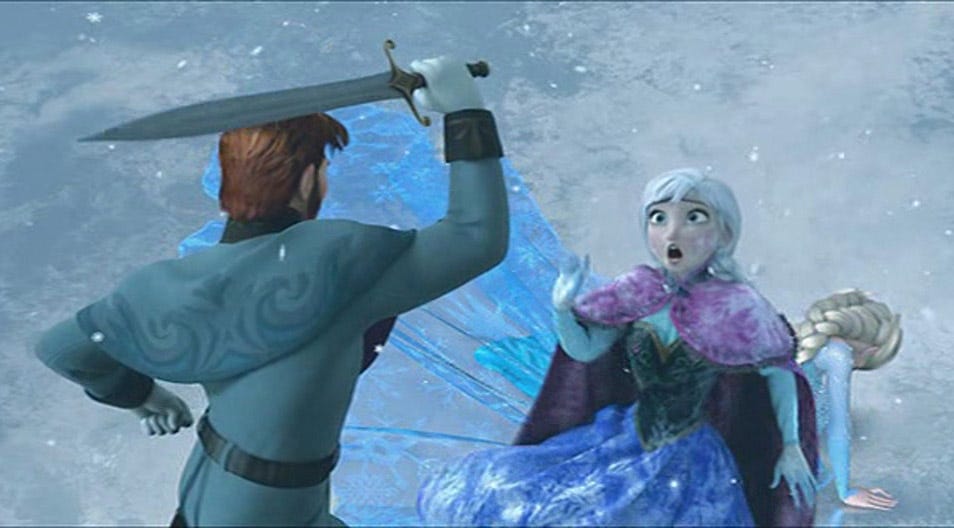
Remember that scene at the end of Frozen where everything’s unravelling?
Arendelle is stuck in permanent winter. Prince Hans tells Elsa that her sister Anna is dead - because of her. As Elsa lies weeping on the ground, he raises his sword to kill her.
But Anna isn’t dead. As she sees what’s about to unfold, she doesn’t hesitate: she flings herself between Elsa and Prince Hans’s sword, ready to die for her love for her sister.
I know that film by heart from watching it over and over with my daughter when she was about five. She’d sit next to me, on the edge of her seat, wearing her Elsa dress, gazing wide-eyed through her fingers, even though she knew it by heart too.
As the sword plunges down on Anna, she turns to ice, and the sword shatters. Prince Hans is flung back to the ground. Horrified, Elsa clings on to Anna’s frozen body, sobbing.
But then… Anna starts to melt, warmed by her sister’s love for her. Elsa gasps, “You sacrificed yourself for me?” “I love you,” is all Anna says in reply. Olaf gets it: “An act of true love will thaw a frozen heart.”
And that’s the moment everything changes. Not because someone wins… but because someone chooses to give something up.
Self-sacrifice saves the world
In earlier posts, I’ve been exploring what our oldest myths say about how the world breaks down - stories about disconnection, about knowledge without wisdom, about what happens when we lose sight of the whole. But the same stories also tell us about how the world gets put back together.
In almost every story about saving the world, from Harry Potter to the Bible, the turning point is the same: someone chooses to sacrifice themselves.
And somehow, that brings things back into balance and makes everything whole again. The powers that imprison or bewitch us are destroyed or defeated. Images of winter or environmental catastrophe are replaced by ones of flourishing and plenty.
Here’s what fascinates me about this. We talk a lot about resilience nowadays, but rarely if ever do we talk about what it costs. In myths, which take things to extremes to make the point, it costs a life. It reminds me of that TS Eliot line at the end of Little Gidding:
A condition of complete simplicity
(Costing not less than everything.)
For us - we hope - the price won’t be quite that steep. But the consistency of myths in pointing to the need for self-sacrifice makes for uncomfortable reading even so. In times of crisis, we’re told to protect ourselves. But what if the real turning point comes from doing the opposite: from our willingness to give something up?
I, We, World
Let’s look at three different levels, which I’ll call I, We, and World - or, if you prefer, personal, relational, and political.
Start at the I level. One of the defining features of life today is that everything feels like it’s getting both harder, and more selfish. It’s not a coincidence.
Our world is one in which individualism has gone feral, where the ego and the ‘primate emotions’ it hurls at us - cravings, aversions, fear, jealousy, anger, anxiety, always wanting more - are given free rein to run rampant.
What’s the antidote to this? In a nutshell, a different kind of consciousness; one that’s slower, deeper, larger. It’s the kind of consciousness meditators train to be able to find their way to - and the ego resists it like its life depends on it. (There’s a reason contemplative Christians call this process “dying to self”.)
But the more we’re able to access this kind of consciousness, the more we build the power to be able to choose what actually matters over what’s easiest. Like making deliberate choices about how we inhabit and treat our bodies, or spend our time or money, or regard and treat other people - or ourselves. (I find it very hard to put my phone down and stop scrolling. But also easier if I’ve sat down to meditate that day.)
When we do start to “sacrifice” the ego-based version of ourselves and move into this slower, deeper, more conscious way of living, then we can find that - like with Anna stepping in the way of Prince Hans’s sword - it can have surprising results. Like restoring our sense of sufficiency and peace. Rebuilding our attention spans. Deepening our resilience to burnout, and to the kneejerk fight-flight-freeze responses that populists constantly try to kindle.
What about the We level? I think there’s a cost here too. Think of when we show up for someone’s party even though the last thing we want to do is go out, because that’s just what friends do. It’s the cost that makes the connection real. Same story when we do things like parenting, or caring for elderly relatives. All of our relationships that go beyond the merely transactional acquire that greater depth because being connected to each other in this way involves a price.
Or think of all the people in our communities who show up consistently to do unglamorous, unseen organising work, like staffing food banks, helping addicts to recover, caring for people with complex needs, or making places of welcome. It’s the simple, practical kindness that every serious wisdom tradition centres on - and there’s a cost here as well.
Or think of the activists I wrote about last autumn who are defusing far right protests by showing up with cake and curious conversations. There’s a generosity of spirit at work there, in showing respect to people they don’t agree with, leaning into deep listening, above all letting go of the need to win the conversation and be seen to be right - all practices that can help us to bridge divides, resist dehumanisation, and discover what we might have in common.
At World level, finally, Nelson Mandela was a transformational leader in large part because he’d paid such a heavy price, spending 27 years in prison. Vaclav Havel, who went from imprisoned dissident to leader of the Velvet Revolution, had enormous moral authority precisely because he’d refused compromises under communist rule that could have made his life so much easier.
We encounter this in our own lives too. My local vicar, Nicholas Mercer, was a senior army lawyer who blew the whistle on abuse of Iraqi detainees by British soldiers, resulting in his suspension and months of attacks from the Ministry of Defence (and, later, to his being named human rights lawyer of the year by Liberty).
And then there are the cases we’re seeing in the news right now - like federal workers in the Trump Administration who’ve resigned rather than implement policies they found unconscionable, or judges who’ve ruled against the Administration knowing the vitriol it would call down on them from MAGA zealots.
Most of us won't face dilemmas this extreme. But we might well encounter situations in which we face the smaller version: the conversation we've been avoiding, the committee we don't have time for, the post we're nervous to publish. In all these cases, the cost is real. And the moral power when we are willing to pay it may have much bigger impacts than we think.
What are we willing to lose?
None of this is what our default settings push us towards. Every instinct we have - both individually and collectively - is to hold on, to protect what we have, to look after ourselves and those closest to us.
But the stories we tell about saving the world say something else: that the turning point comes when someone chooses to give something up.
So maybe the question for us isn’t whether this moment will cost us something. (It will.) Maybe it’s what we’re willing to lose.
Links I liked
Fascinating stuff here from Daniel Pink on the results of an experiment where people turned off their smartphones for two whole weeks.
I liked this by Renée Lertzman on the four “cabals” that make up the world of changemaking.
Vice had this on seven mental coping strategies for the end of the world.
I’ve been thinking about the word “sacrifice” for the last few weeks and, as I understand it, the origin of the word is not so much about giving something up but about offering something up to God who then “makes it holy” (sets it apart) and returns it in a way that benefits the community eg offering up a goat which is then returned for a feast. This ties in with “dying to self” and to Paul’s exhortation to offer ourselves up as “living sacrifices”.
I think we too often diminish the idea of sacrifice in our everyday use of the word and your article helps to reclaim a better understanding of what it means.
Really helpful Alex, makes me think of Bonhoffer's book (and life) The Cost of Discipleship. Funny that Nicholas Mercer is your local vicar, he became chaplain at Sherborne when I was teaching theology there (we crossed over for a term I think).