

The most extraordinary man I ever met
The African-American blues musician with a closet full of KKK robes

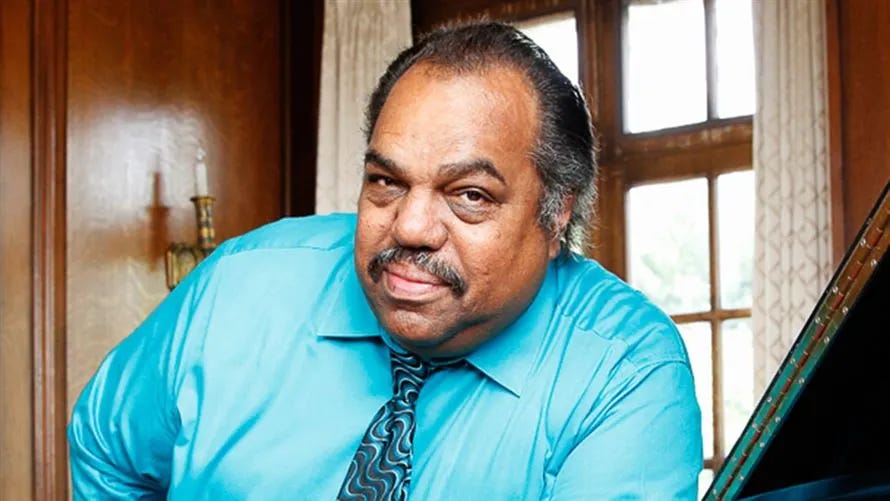
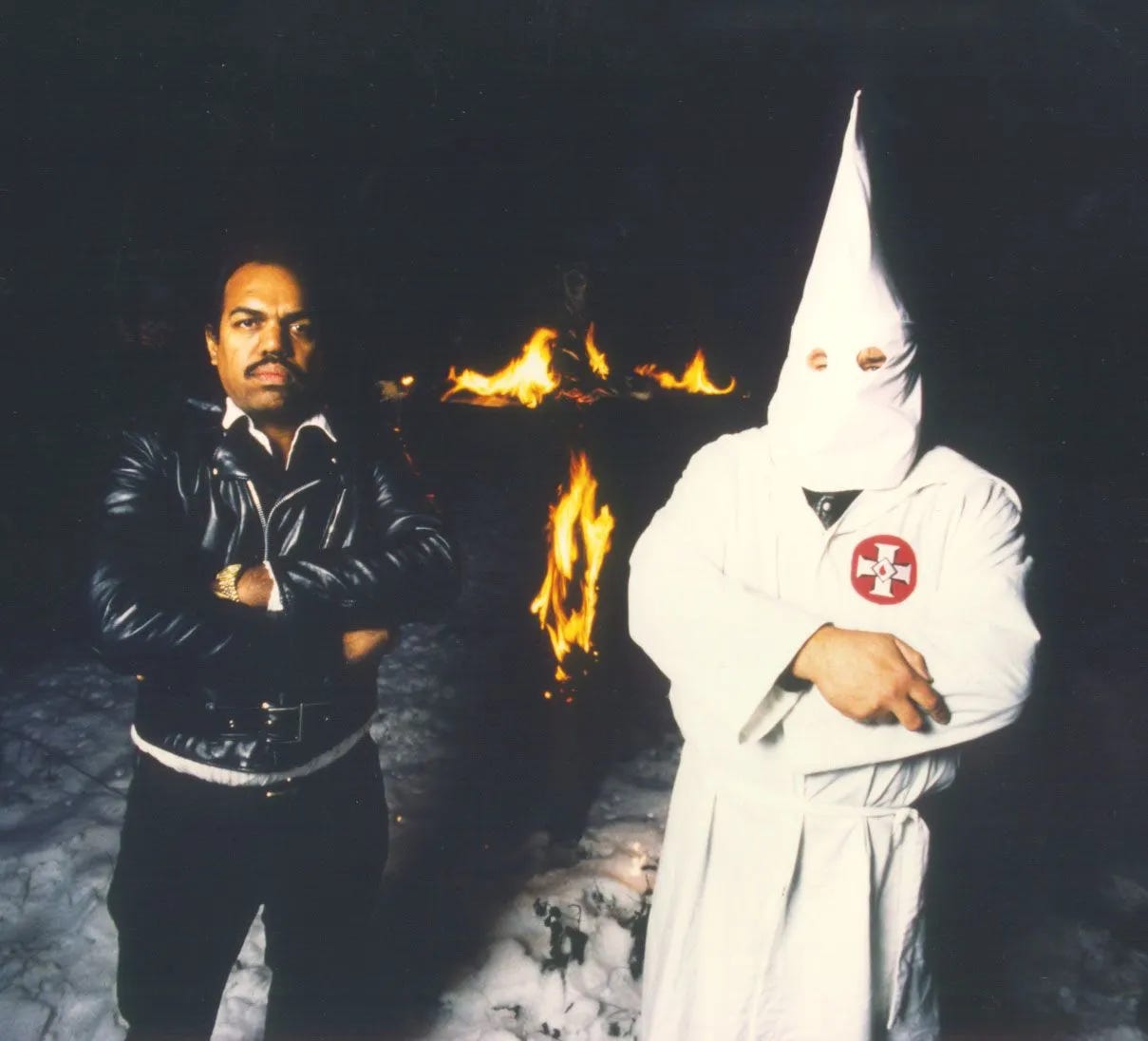
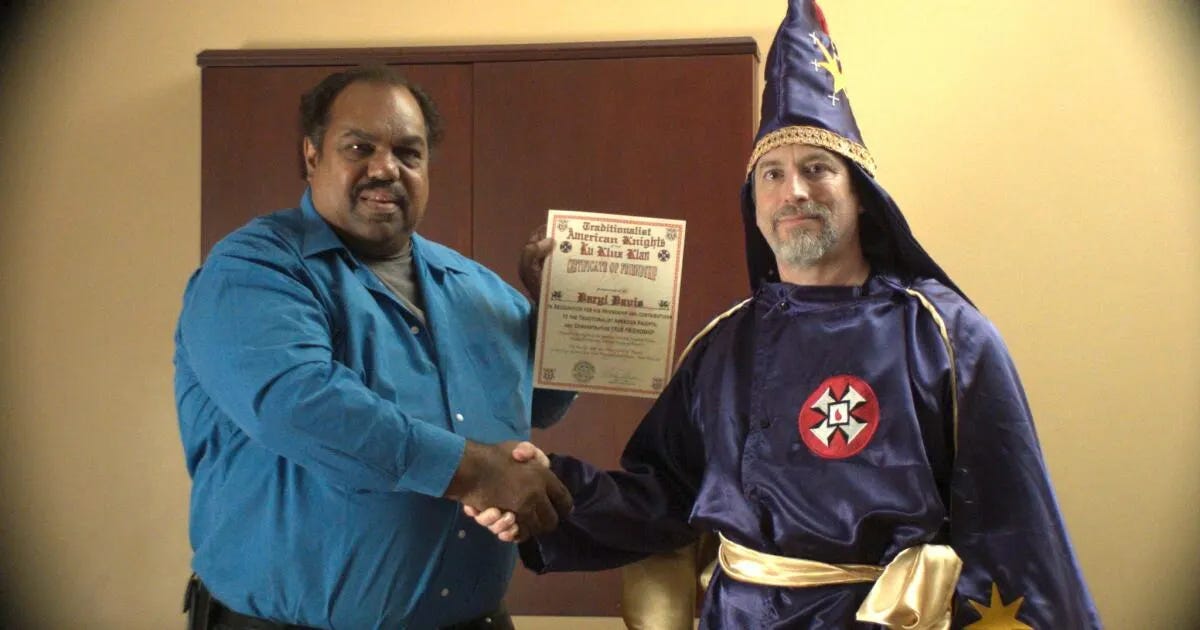
Daryl Davis is an African-American blues musician. He’s played with Chuck Berry, BB King and Jerry Lee Lewis. He’s also spent decades befriending members of the Ku Klux Klan - not to convert them, he’s always careful to say, but to understand them. More than two hundred Klan members have left the organisation after getting to know him, and have given him their robes as a result. He keeps them in his house.
This is a conversation I had with Daryl, recorded jointly with my friend and Larger Us board chair Elizabeth Oldfield, who writes Fully Alive here on Substack and hosts The Sacred podcast.
It’s a story about curiosity instead of fury, about what it takes to stay in a room with someone whose views you find abhorrent, and about why attacking someone’s sense of reality almost never works - however wrong you believe that reality to be. It’s as relevant to where we find ourselves now - with division spiking nationally and around the world - as it is to the extremes Daryl has spent his life walking into.
Although this conversation took place a while back, I wanted to publish this edited transcript now because in a week’s time, Larger Us will be launching a report by my colleague Luisa Melloh that we’re incredibly excited about, which pulls together the evidence on conversations as a tool for campaigning and social change: what works, what doesn't, and why. (More on that in another Substack very soon.) For now, though: here’s the most extraordinary man I ever met.
Content warning: what follows contains a description of a violent and racist incident, and the use of offensive racist language in that context.
Elizabeth Oldfield
I’m always really curious about someone’s guiding values — I think they tell us a lot about the trajectory their life has taken. I frame it as “what is sacred to you,” but you can answer however you like. What are the principles that have undergirded your life?
Daryl Davis
Well, I have a lot of principles that guide me, but I think two of the most important to me would be trustworthiness and honesty. I look for those in other people, and I try to exhibit those in myself.
I learned that as a child. When people would promise me things, and they didn’t do it, it was a real letdown, because I was really expecting it. But when they would go to extreme lengths to fulfil what they promised to do, that meant a lot to me. So I would try to also exhibit those kinds of things. If I told somebody I would do something, I would follow through, regardless of how hard or difficult it might be — unless it was just impossible, or I was incapacitated in some way.
Elizabeth Oldfield
Beautiful — I think trustworthiness feels like a very good thing to be trying to live by. Could you tell us a little bit about your childhood, and particularly the formative context of having moved around so much?
Daryl Davis
Yes, sure. My parents were US State Department, so I grew up as an American Embassy kid. I’m 66 years old now. I was born in 1958, but I began travelling around the world at the age of three, in 1961.
How it works is you get assigned to the American Embassy abroad for two years, and then at the end of that assignment you return back home here to the States. You may be here for a year, and then you get assigned to another country for two years. So back and forth, back and forth, were the formative years of my life.
My first exposure to school was abroad. I did kindergarten and first grade, third grade, fifth grade, seventh grade, all in different countries, and the in-between grades I would do back home. My classes overseas contained kids from all over the world — anybody who had an embassy where we were assigned, all of their kids went to the same school. The one over on this side of my desk might have been from Yugoslavia. The one on this side might have been from Russia, or Japan, or China, or France, or Nigeria. Whoever had an embassy there, all of their kids went to the same school. That was my baseline for what school was supposed to be, and we never had any issues with racism. Sure, we looked different, we came from different places, we spoke different languages, but we were kids — we played together, we worked together, we spent the night at each other’s houses.
However, when I would come back home at the end of my dad’s assignment, I would either be in all-Black schools or the newly integrated schools, and there was not the amount of diversity in my classroom that I had overseas — even though our US Supreme Court had passed desegregation four years before I was born. Schools did not integrate overnight. It took years and years.
One time I came home — it was 1968, I was ten, in fourth grade, in one of those newly integrated schools. There were only two Black kids in the entire school: myself, in fourth grade, and a little Black girl in second grade. Most of my friends were fourth graders, and they all were white. Several of them were members of the Cub Scouts, and they invited me to join, so I joined. I was the only Black scout anywhere in the area.
Alex Evans
You grew up in conditions where difference and diversity were the norm, at least when you were on the foreign postings. How did that shape you temperamentally? Did it lay the foundations for you being able to be curious about people, to be empathetic, to see the world through different eyes?
Daryl Davis
That in itself did not make me curious about other people — that was the norm for me. I didn’t really know any difference, and we all got along. There was no reason for me to think anything different of these people just because they didn’t look like me.
What made me conscious of it, and put me on that trajectory, was the fact that I didn’t know I was any different. When I joined the Cub Scouts in 1968, I was the only Black scout around, and we had a parade with a bunch of other groups. I was the only Black participant. The sidewalks were lined with white people waving and smiling and cheering — until we reached a certain point along the route, when I started getting hit with bottles, rocks and soda cans by a small group of spectators off to my right.
I turned to see who was throwing things, and saw a little group of two or three kids and two adults. My first assumption was, oh, these people don’t like the Scouts — that’s how naive I was. It wasn’t until my scout leaders came running over and covered me with their own bodies that I realised nobody else in my troop was getting some special protection. Now I’m wondering, what did I do? They just said, “Move along, hurry up.” They never answered my question.
When I got home, my mother and father — who hadn’t been at the parade — saw me with blood, scabs, bruises, and asked how I’d fallen down and got all scratched up. I told them I had not fallen down, and told them what had happened. They cleaned me up, put on band-aids, and then sat me down and explained to me, for the first time in my life, what racism was.
I had never heard that word. I was ten years old. And I didn’t believe them, because my brain could not process the idea that someone who had never seen me, never spoken to me, who knew nothing about me, would want to hurt me for no reason other than the colour of my skin. To prove I was right, I thought of my closest friends, whether at school here or overseas — my Danish, Swedish, French, Norwegian friends — they looked the same as the people on the sidewalk. They didn’t behave like that. So skin colour had nothing to do with it.
Well, I was wrong. This was 1968, and a lot of things happened that year, culminating with the assassination of Dr Martin Luther King Jr. I saw it — I saw the buildings burning, the violence in the streets, people going crazy. And then I realised my parents had not deceived me. This phenomenon I’d never heard of, racism, does exist.
But what I did not know was why. It’s just a stupid thing, right? So I formed a question in my own mind, at the age of ten, which was: how can you hate me when you don’t even know me? And I’ve been looking for the answer to that question now for fifty-six years. I bought books on Black supremacy, white supremacy, the Ku Klux Klan, antisemitism, the Nazis in Germany, the neo-Nazis over here. They did not answer the question to my satisfaction. And when I would ask people directly, “How can people hate somebody just because of the colour of their skin?” — they’d say, “Oh Daryl, some people are just like that, that’s just the way it is.” That did not placate me.
So who better to ask that question of than someone who would go so far as to join an organisation with a history of hating people — I’m going to hate the Jews, I’m going to hate the Blacks, I’m going to hate the gays, the Muslims, anybody who doesn’t look like them or believe as they believe. That’s what piqued my interest in the Ku Klux Klan and similar organisations.
Alex Evans
And when did you first meet somebody from the Ku Klux Klan?
Daryl Davis
The first person I met from the Ku Klux Klan, I beat him up. Pretty badly. What happened was — I’m an adult, a professional musician, I’d just finished a gig, and I went to an all-night restaurant to get something to eat, about 2 o’clock in the morning. I’m pulling into the parking lot, and there on the sidewalk, right outside the restaurant, are about four or five white guys standing, watching something. There’s a woman lying on her back on the sidewalk, and a man sitting on her chest, banging her head into the sidewalk and hitting her across the face — and these guys are just standing there watching.
I’m parked maybe twenty feet away. He’s totally oblivious to me pulling in. I got out to go pull him off, and when I got out of the car, I slammed the door. He jumped up, looked at me, and said, “You want a piece of me, n*****?” I said, “Yeah, I do.” He ran over to attack me, and I let him have it. I beat him pretty severely.
One of the people watching went and called the police — they didn’t call when this white guy was beating the daylights out of the white woman, only once I’d beaten the daylights out of him. The cops came, and I wanted the guy arrested. They would not arrest him. “We didn’t see what happened,” they said. Something was very strange and I couldn’t put my finger on it. I wanted his address and name — they had to give it to me. They told him if he came back on the premises within 24 hours, they’d arrest him for trespassing, so he left.
I went inside, got a towel, put some ice in it, took care of the woman, and gave her my name and number — said if she wanted to take him to court, I’d come as a witness. On the way to court, she told me he was a Klansman. I didn’t know at the time, but it didn’t matter to me — he was wrong for what he was doing. She also told me he was a high-ranking fireman in the local fire department, which explained why the cops wouldn’t arrest him. That was my first encounter.
My second went a lot differently. I was playing a gig in the same town, at an all-white bar called the Silver Dollar Lounge, with a long-standing reputation for being unwelcoming to Black people. No signs forbidding it — just a feeling you didn’t go there. I joined the band, which had played there before, and on a break, I felt somebody put their arm across my shoulder from behind. I turned around, thinking I was about to get into another fight, and saw an older white guy, maybe fifteen to twenty years older than me, big smile on his face.
“Man, I sure love yall’s music,” he said. I thanked him and shook his hand. He pointed at the stage and said he’d seen the band before, but never me — where had I come from? I explained I’d just joined a couple of months back. “Well, I sure love your piano playing,” he said. “This is the first time I ever heard a Black man play piano like Jerry Lee Lewis.” I wasn’t offended, just surprised, because he didn’t know the Black origin of Jerry Lee Lewis’s style. I explained that Jerry Lee got that style from the same place I did — Black blues and boogie-woogie piano players. He didn’t believe it, even when I said Jerry Lee was a good friend who’d told me himself.
He wasn’t convinced I knew Jerry Lee either, but he was fascinated, and wanted me to come back to his table for a drink. I don’t drink alcohol, so he bought me a cranberry juice, and clinked my glass with his. “This is the first time I ever sat down and had a drink with a Black man,” he said.
By this point in my life I’d sat down with thousands of white people. How could this man have lived this long and never done that? I asked why. He looked down at the table. I asked again. His buddy said, “Tell him, tell him.” He looked back at me. “I’m a member of the Ku Klux Klan.”
I started laughing — I thought he was joking. I know a lot about the Klan; they don’t behave that way. While I was laughing, he went into his pocket, pulled out his wallet, and handed me his Klan membership card. I realised it was real, and gave it back to him. Now I’m questioning myself: what am I doing sitting at this table with a Klansman? But he was very friendly, gave me his phone number, wanted me to call any time I was back with the band, because he wanted to bring his friends — Klansmen and Klanswomen — to see me play “like Jerry Lee Lewis,” as he put it.
So I’d call him every six weeks or so, whenever we came back. He’d come with his Klansmen and Klanswomen — they’d sit near the stage, watch me play, get out on the dance floor. Afterwards I’d go to his table to thank them. Most would stay, curious, wanting to meet me, talk to me. Two of them would get up and walk to the other side of the room when they saw me coming — the implied message being, we don’t want to shake your hand or touch you, we just want to look at you.
That went on until the end of that year, when I quit the band and went back to rock and roll and R&B. A few years later it dawned on me: I’d had the answer to my question fall right into my lap, and I hadn’t realised it. Who better to ask “how can you hate me when you don’t even know me” than a KKK member? That’s what they do — they hate people.
I still had his number, though by then it had been disconnected. I tracked him down to a new address and just showed up at his apartment one evening. He opened the door, startled — “Daryl, what are you doing here?” — and stepped out into the hallway, looking up and down to see if anyone was with me. When he stepped out, I stepped in.
I told him I needed to talk to him about the Klan. He said he’d quit, gave me a long explanation why. I told him I wanted to write a book on the Ku Klux Klan, starting right there in Maryland, with the head of the state Klan — a man named Roger Kelly — and I wanted him to introduce me.
He didn’t want to. He was fearful for his own safety and mine. “You’re not a member anymore,” I said. “It doesn’t matter,” he said. “I cannot take a Black man to Roger Kelly.” I begged and pleaded. Finally he gave me Kelly’s number and address, on the condition I never told him where I’d got it. He warned me: “Darryl, do not fool with Roger Kelly. Roger Kelly will kill you.” I said, “Well, that’s why I need to see him. Why would he kill me just because of the colour of my skin? I have to understand this.”
Elizabeth Oldfield
You use this phrase, which has really stuck with me, because I aspire to it. You say “I get curious, not furious.” It’s so key in your story — how much this question has bugged you, that wanting to find the answer was sufficiently motivating for you to go and see someone who could have killed you, and later make friends with him.
Daryl Davis
I was friends with people who looked just like Roger Kelly. That debunked my theory — well, I didn’t have the theory that the colour of somebody’s skin makes them who they are. They think the colour of my skin makes me who I am — a criminal, a drug dealer, a pimp, on welfare. Inferior. That’s what makes them a supremacist: they are supreme, they are superior, and if somebody is superior, somebody else has to be inferior.
The fact that I had friends who looked like Roger Kelly told me skin colour has nothing to do with it. One Klansman was very nasty to me and tried to attack me, and I had to violently beat him down. The other was putting his arm around me, wanting to buy me a drink. They were the same colour. If I can see a difference in people of the same colour, why can’t you?
That was my mentality. I was very naive — I didn’t know why people were throwing rocks at me. People always ask, “Why didn’t your parents prepare you for this?” I’ve thought about that. But in retrospect, I’m glad it worked out this way. If my parents had told me early on that some white people don’t like Black people and may hurt me, I’d have been looking at every white person with suspicion — pre-judging them. That’s exactly what the Klan does: they see my skin colour and make an assessment about me before they know anything else. I’m glad my parents didn’t plant that prejudice in me.
Elizabeth Oldfield
We’re really interested in what is the actual postures and practices you’re adopting when you’re befriending someone who is not just a different skin colour from you, but has a completely different way of seeing the world — because your reaction to the Klansman in the bar wasn’t to flip the table, but to stay in conversation, and get to the point where Roger Kelly handed over his robes to you. What is it about how you approach those encounters that lets you see each other as complex human beings, not just signifiers of groups?
Daryl Davis
Let’s understand something. I never set out to befriend any Klan people. I never set out to convert any Klan people. When you see my name in the media, it says “Black musician converts X number of white supremacists.” That is not true. I am the impetus for over 200 people to convert themselves.
We’ve all heard the expression that a tiger does not change its stripes, a leopard does not change its spots. That’s true — that’s who they are, born with those stripes and spots. I was under the notion that a Klansman doesn’t change his robe and hood, that that’s just who he is. I had no intention of being friends with these people. All I wanted to know was how can you hate me when you don’t even know me. You give me the answer, I thank you, and we go our separate ways.
But I was wrong. A Klansman, unlike a tiger or a leopard, isn’t born with that robe and hood. They acquire it, they learn it. And what can be learned, can be unlearned. I didn’t realise that when I went in. Over the course of time, and conversations, and interviews, I saw things changing with them.
Here’s how it works. When somebody thinks they’re superior to you, they don’t ask you any questions — you ask all the questions. It’d be one-way, unless it’s another supremacist talking to them. Then one day I’d ask what they thought about some policy, and they’d ask back, “What do you think, Daryl?” That caught me off guard. I’d made one little modicum of progress, because now they’re interested in me.
I always gave honest answers. If I knew something for a fact, I told them, and gave them a trustworthy source where they could check it themselves. If it was my opinion, I always said so — because if my opinion turned out wrong, it would just reinforce what they already thought about me. So I was always transparent.
Then they’d start asking more questions, finding out what I said was true. They’d go home thinking: I just had a three-hour conversation with a Black man, and we didn’t come to blows — and what that Daryl guy said is true. But he’s Black. They’re experiencing cognitive dissonance — they know what I said is true, but their prejudice resists it. So they have to resolve a dilemma: do I disregard his skin colour and believe it’s true, and change my ideological path, or do I keep living a lie because of his skin colour? Most people choose the path of least resistance and go with the truth.
The harder cases are the leaders — Exalted Cyclops, Great Titan, Grand Dragon, Imperial Wizard. They’ve sat on a throne of power, recruited followers who treat them like celebrities, get autographs, get their photo taken with them. Even if they know they’re wrong, they have to think about giving up that power, and how to tell the followers they recruited, “I was wrong.”
Alex Evans
Daryl, what have you learned about what leads people to become white supremacists in the first place? One of the things we’ve noted in our research at Larger Us is how extremist groups often attract people by offering a twisted kind of belonging, based on who’s excluded, but belonging nonetheless. There’s also psychological research about how, when people grow up with chronic shame, it can create a self-protective rage they externalise onto a scapegoat. Have you seen these things in your conversations, or do you have a different theory?
Daryl Davis
You’re absolutely right, there’s a lot of that. People want to belong, they feel ostracised by society — where do I fit in? That’s exactly what the Klan looks for: people who are vulnerable, looking for something.
I’ll give you a few more reasons. It could be family tradition — my grandfather was in the Klan, my father was in the Klan, I’m in the Klan, my kids are going to be in the Klan. Just the way it is, the way people would tell me. Or you might move to a town that’s a Klan stronghold — they run everything — and you want to assimilate, do business there, so you join the local Chamber of Commerce, the local country club, the local KKK, and that gets you in. Like a gang controlling a block — you join to defend yourself from other gangs.
Another reason is economic. Take coal mining towns — most coal miners, back in the day, were white people, going right into the mines out of high school, generation after generation. Then people start immigrating, willing to work for less, and the coal companies, being greedy, lay off the existing white workers to hire them more cheaply. These workers don’t know any other trade. The bank’s knocking on the door for the house.
The Klan comes into a town like that, holds a rally: “The Blacks have the NAACP, the Jews have the ADL — nobody stands up for the white man but the Ku Klux Klan. Your job’s not gone, but you’re gone. Some racial epithet has your job. Come join us, we’ll get your job back.” People who were never racist, who were happy, working, feeding their families — they start thinking, well, they do have a point. My job’s still there, I just don’t have it anymore. They said they’ll get it back. What do I have to lose? They take a blood oath. That becomes their family.
Elizabeth Oldfield
Daryl, you speak so persuasively about empathising with people, putting yourself in their shoes — and I know that’s the fruit of years of listening, driven by curiosity. Both in my work on The Sacred, where some guests make my audience angry that I’d even be seen with them, and in the core of bridge-building work, this requires real inner work — steadying yourself, getting your fight-or-flight under control, so you can respond with curiosity rather than reactivity. But the pushback we get — and that I’m sure you get — is: why should you, particularly as a Black person, be doing the work of going to the Klan? Why should we be listening to people who are clearly abhorrent? Isn’t it somehow colluding with the enemy?
Daryl Davis
Yes, I get that. I have my share of detractors. Sometimes I’ve made friends out of detractors; other times, people on both sides will go to their grave feeling hate, racism, violence, no matter what. Some Black detractors say it’s not our job to teach white people how to treat us well. My response: you’re absolutely right, it shouldn’t be anybody’s job. But when you’ve been mistreated for 400 years and you’re still being mistreated 400 years later, maybe it’s time to change the approach. I have an approach that works. How many Klan robes do you have hanging in your closet? That’s the dent I’ve put in racism. What have you done?
On the platforming point — if you asked my detractors, “Don’t you wish those people could change, could see the light?”, most would say yes. Well, how are they going to see the light without seeing somebody who’s already enlightened? You are the light they need to see.
There’s something else, too. We’ve all heard the expression that one’s perception is one’s reality — that’s very true. Whatever somebody perceives becomes their reality, even if it’s not real. If you know it’s not real and try to tell them, you’ll get resistance, because you’re attacking their reality — and that’s the beginning of most conflicts, whether racial, political, whatever it is. The more you attack somebody’s reality, the more the problem escalates.
If you want somebody’s reality to change, what you must do is not attack the reality — offer them a better perception. If it resonates with one of your perceptions, they’ll change their own reality, because the perception becomes the reality.
Here’s an example I like to give. Say your younger brother goes to a magic show and comes home telling you the magician sawed a woman in half on stage, that she wiggled her feet out one end of the box, then he talked to her head at the other end, then put her back together with no blood — and he saw it with his own eyes. If you say, “Listen, it didn’t really happen like that, it’s an illusion,” he’s going to get angry — maybe even punch you — because you’re calling him a liar. You weren’t there. He was. How dare you tell him he didn’t see what he saw?
But instead, you could say: “Listen, I understand what you’re saying — but is it possible the lady was planted in the audience, that she travels with him to every show, sits in the same seat every time so he can find her? Maybe when she climbs into the box, there are already a pair of mannequin legs lying there, wearing the same stockings and shoes, and she pushes those out the hole while tucking her own legs up under her chest. So when he saws the box, the saw never touches her. And when he moves to talk to her head at the other end, he’s distracting you from looking at those still feet.” Now you’ve offered him a better perception. If it resonates, it becomes his new reality.
Don’t waste time attacking somebody’s reality. All you’ll get is resistance, and it can even explode into violence. Even if you’re triggered by it, don’t attack somebody’s reality — just offer them a better perception.
Alex Evans
Darryl, we’re almost at time. But I did want to ask — just briefly — what are your reflections, both on America, where so many of the issues we’re talking about are right to the fore, but also, to bring it down to earth: what steps could listeners take to draw on your experience and the approach you’ve pioneered? Especially listeners in a very polarised situation like the US, but more generally too — how can people start to put what you do into practice?
Daryl Davis
This country has been a white supremacist country for basically 400 years, since we came here — I’m a descendant of slaves who arrived in 1619. When you’ve sat on the throne of power for 400 years, that’s all you know, that’s your reality. You don’t want to get off. If you want something to change that hasn’t changed in 400 years, then you have to be the change you want to see.
We call many other countries “third world countries.” I don’t like that term. Perhaps we’re a first-world country technologically, but ideologically, we’re a third-world country. There are third-world countries with female presidents, female prime ministers. All we do is debate whether a Black man can be president, a Mormon, a woman. Who cares what religion, gender, colour they are? Can we have a president who can lead this country? That should be the focus. And in order to bring that about, we have to be the change.
Links I liked
Daryl’s TED talk is here.
“Hundreds of billions of dollars in new philanthropic capital will soon become liquid. The OpenAI Foundation holds 26% of OpenAI, worth about $220B at today’s valuation. Anthropic’s seven co-founders have pledged to give away 80% of their wealth and have instituted the most aggressive donor matching program for employees in tech history.” What will this sudden flood of cash mean for non-profits? This piece by Nan Ransohoff was superb.
“Over the next two decades digitized gambling swept the casino industry. With 10 percent of the gamblers providing 80 to 90 percent of the take, anything that speeded up and extended play among regulars was bound to grow revenues … As with resort architecture, what happened in Vegas did not stay in Vegas.” Absolutely gripping piece on how digital gambling taught tech companies how to make smartphones and social media addictive.
I’ve been so enjoying Turi Munthe’s new book Why We Think What We Think - his Substack piece about it is here.
Thanks Alex, Elizabeth, and Daryl. This is precious!
Thank you Alex for sharing this. Daryl's question, "How can you hate me when you don't even know me?" is both simple and profound. What stands out to me is the role of curiosity throughout his story. Not curiosity as agreement, but curiosity as a willingness to understand what lies beneath beliefs and perceptions. In a polarized world, that feels like an increasingly rare and valuable capacity.