

None Of The Above
Why being politically homeless might be the most interesting place to be right now

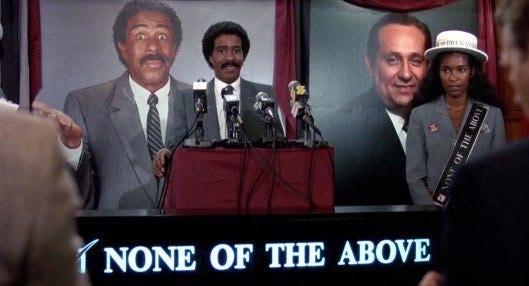
If you were watching comedy movies in the 1980s, you might remember a film called Brewster’s Millions. It’s a Richard Pryor comedy about a Minor League baseball player who accepts a challenge to spend $30 million in 30 days in order to inherit $300 million from his great-uncle. The bit I always remember with a chuckle is when Pryor’s character hits on the idea of sinking his cash into an election campaign for “None of The Above”.
On which note let me ask you: how are you feeling about the local elections this Thursday? Despairing, if you’re a Labour or Conservative supporter? Gleeful, if you’re more Green or Reform minded? Or maybe you’re politically homeless like me - and what you’re thinking, mutinously, is: “None of The Above”.
The strange symmetry of British politics
At one level, of course Labour looks very different from the Conservatives, just as the Greens look very different from Reform. But in other ways, there are fascinating symmetries.
Start with Labour and the Tories. Both are historically parties of the centre, now struggling to respond to successful attacks from the fringes. As a result, both have flirted with levels of political nastiness that would have been unthinkable in decades past, from the Conservatives cheerfully saying refugees should “go back where they came from” to Labour proposing to confiscate their jewellery.
Both have diminished themselves through factionalism - in the Conservatives’ case, expelling 21 pro-European MPs in 2019, in Labour’s through Morgan McSweeney’s purge not just of Corbynistas but even the ‘soft left’, especially through his iron control of Parliamentary candidate lists before the last election. Both have also forfeited large amounts of trust amid stories of sleaze and double standards.
Above all, neither has anything that begins to resemble a plan, a compelling narrative, or a vision of where we’re trying to get to - at a time when all of us are desperate for something to say yes to, a positive alternative, something that makes us feel that things are actually going to get better rather than just worse a bit more slowly. Good luck finding that from Labour or the Tories right now.
And then there are the populists of left and right - and here too, symmetry abounds. Lots of people are willing to give them a try. I myself was sufficiently tempted that when I finally left Labour after 25 years’ membership, I joined the Greens instead. I lasted less than a month, and the reasons, I think, speak to a broader pattern.
It’s not hard to see the attraction: the punchy narratives, the sure-footed social media presence (such a contrast with Labour and the Tories), the promise of deep-rooted change rather than dreary deliverism, above all the sugar rush of the mess we’re in all being someone’s fault (refugees! billionaires!).
And then there are the other symmetries. The little hypocrisies - from how a former City commodities trader presents himself as a champion of the working class at Reform, to how the Greens so often side with NIMBY opposition to renewables projects. The lack of experience of government. The fact that their fiscal plans manifestly don’t add up.
And then there’s the prejudice. Reform barely even bothers to hide its Islamophobia these days - as with its dog whistle announcement that it will ban churches from being turned into mosques. The Greens, meanwhile, run the real risk of becoming a new home for anti-semitism on the left: just last week, two candidates were arrested for social media posts, one of which showed an armed man wearing a Hamas headband with the slogan “Resistance is freedom”.
All of which leaves me - and I suspect quite a lot of others - feeling distinctly Richard Pryor about the options on offer in the polling booth this week. So what are we going to do about it?
We don’t need another party
Here’s the problem. For at least 15 years now - some would argue a good deal longer - it’s the insurgents who’ve been the ones setting the agenda, both within and outside mainstream parties: Nigel Farage, Jeremy Corbyn, Boris Johnson, and now Zack Polanski. Centrist leaders like David Cameron, Theresa May, and Keir Starmer trail along flat-footed in their wake by comparison, repeatedly running the same strategies.
One is to badge themselves as ‘populists-lite’, as both Tories and Labour have been doing on immigration of late, which fails because it begs the obvious question of why you wouldn’t just choose the real thing (as, research shows, voters duly proceed to do).
The other is to warn against the dangers of populism and try to get people to vote for you out of fear. It’s what Cameron tried with Brexit, and it’s what Keir Starmer is attempting to do right now as he defends against threats on two flanks. The problem, of course, is that this strategy inevitably casts you as the boring incumbent defending a status quo that everyone’s fed up with.
What about starting a new party of the centre, as Change UK tried to do amid the post-Brexit chaos of 2019? Pity the eight Labour MPs and three Conservative ones - including big names like Chuka Umunna and Anna Soubry - who left the parties of Jeremy Corbyn and Boris Johnson to try and “fix politics” from the pro-European centre. As things turned out, every one of them lost their seats in that year’s general election, and the party dissolved itself two months shy of its first birthday. As the dust settled, its founders variously attributed its failings to First Past The Post, big political egos, and the media environment’s tendency to spotlight more divisive platforms - all problems that would immediately beset any new centrist party today.
And let’s be real here. Even if by some electoral miracle a new political party - one with great leadership, great policies, and a great story - won a landslide at the next election, it would at best only hang on to power for a decade (and probably just a single term, given the volatility of politics today and the intractability of the challenges we face). What happens after that? Back to the clown show?
Here’s the thing I keep coming back to: the challenges we face need a much longer-term approach. Take any of the really big issues - decarbonisation, health, transport, education, housing, social cohesion, emerging tech, or building local, national and global resilience - and it’s blindingly obvious that these are not problems you solve in a single Parliament. They’re problems you have to navigate across generations.
What we need here isn’t a single party that works. It’s a system that works.
What if we stopped waiting?
What would that involve? Start with what it is that we currently look for from our political parties - which, when you get down to it, is really three key things.
One is a compelling vision: a story about where we are, how we got here, where we’re trying to get to, and who we are. (Nowadays, populists are often the ones that have this; centrists, not so much.)
Second, we want them to have a clear plan. Not just a destination, but a map for how to get there, made up of properly thought through policies, institutions, spending plans and so on. (Populists definitely don’t have this. Increasingly, though, neither do the centrists.)
And third, we want them to have a credible organising infrastructure that can win elections, that gives us confidence that we won’t be wasting our votes and that the party we support will actually have the chance to take us on the journey set out on their map. (This used to be a key advantage for centrists, given membership numbers plus First Past The Post - but less and less so.)
Now take a step back and ask: why does it have to be a political party that delivers these things? Why are we sitting here passively waiting for some set of politicians, policy wonks and spin doctors to package it up and then spoon-feed it to us?
Because looking around, there are some quite intriguing signs of citizens starting to do all three of these things themselves.
Start with the vision of the shining city on the hill that we might be trying to get to: a resonant story about the future we’re trying to build and our role in building it, probably the single biggest thing that Keir Starmer has been criticised for lacking. Can citizens come up with such a vision?
For one response, look at Avaaz, the 70 million member online citizen’s movement where I was a campaign director before I set up Larger Us (I’m now a trustee). This year, it’s planning a hugely ambitious new project to consult millions of people around the world on their vision of a thriving future, which will become the basis of a manifesto that guides the organisation’s campaigns.
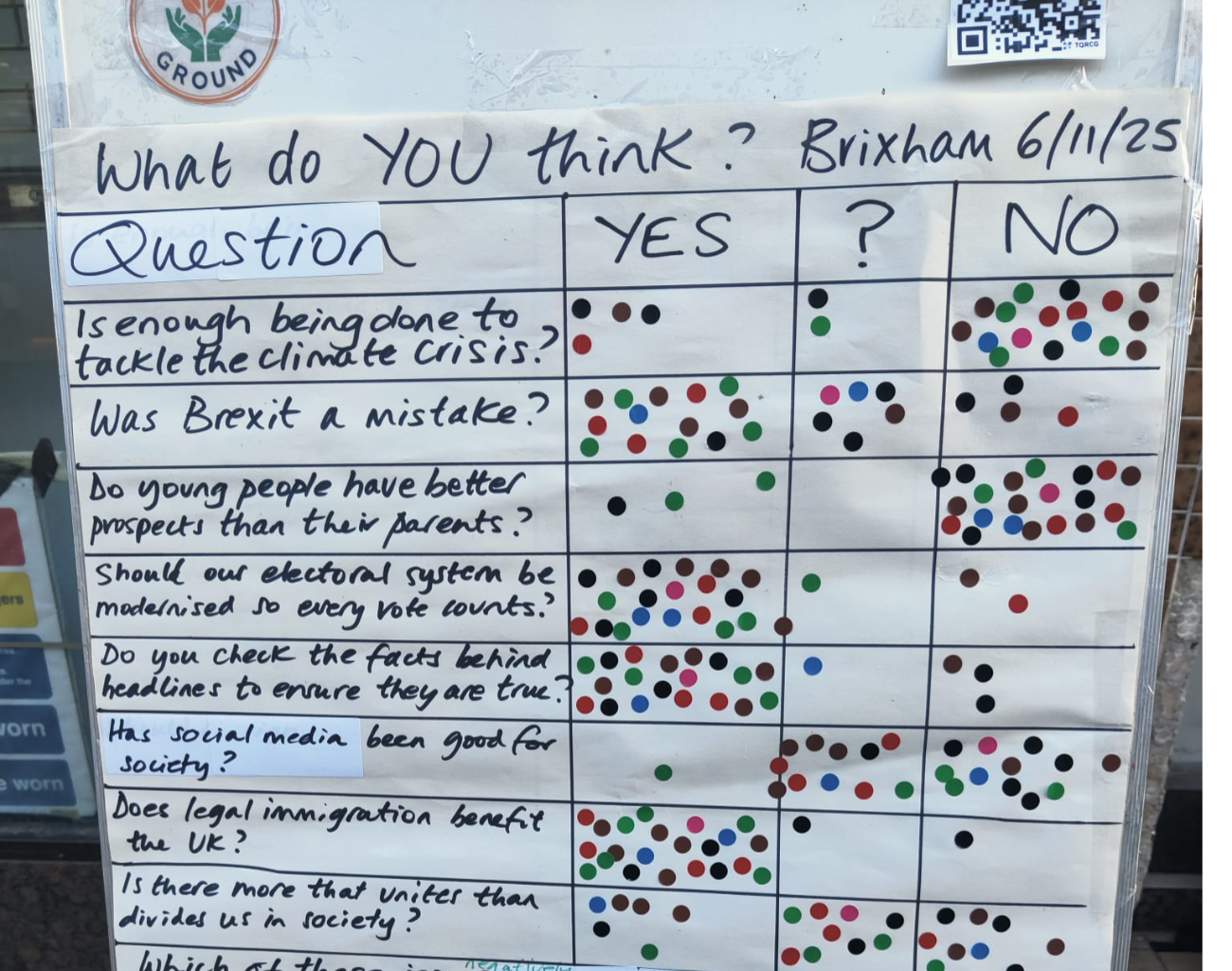
There are plenty of more local examples, too. My friend Anthea Lawson is part of a group doing something beautifully simple - going onto local high streets and asking people what they actually think:
Then there are the examples of citizens working through real world trade-offs and prioritisation decisions to come up with a plan. I’ve written before here about Pol.is - the digital platform that Taiwanese ‘civic hacker’ Audrey Tang has championed, which is now being used to imagine new futures in Grimsby.
At its heart, Pol.is is a software platform for large group collaborations. Created by veterans of Occupy Wall Street and the Arab Spring, it lets people share their opinions and ideas, and then identifies areas of contention and agreement in a way that “gamifies consensus” and can bypass special interest groups. Here’s what Tang herself had to say about it on a podcast:
Polis is quite well known in that it's a kind of social media that instead of polarizing people to drive so called engagement or addiction or attention, it automatically drives bridge making narratives and statements. So only the ideas that speak to both sides or to multiple sides will gain prominence in Polis.
Finally, there’s organising for elections. Yes, political parties have the biggest organising infrastructures. But they’re not the only ones: trade unions often coordinate their members’ votes, for instance. And it’s becoming increasingly possible for ordinary citizens to do the same. As I wrote in a post about the idea of a ‘people-powered insurgency’ last June,
I love the story of the South Devon Primary, where local people ran a series of hustings and a primary election, picked their preferred candidate, and then voted for her en masse (in the process electing their first non-Conservative MP in 100 years).
Political parties hate this kind of thing, because they lose so much control. (The Lib Dems’ chair for England wrote to all candidates to tell them that “under no circumstances are you to take part” in processes like this, threatening them with deselection. Their South Devon candidate ignored him, and won.)
Imagine how much more we could do. If we ran local primaries like South Devon’s all over the country. If we took the results from representative local citizens’ assemblies and demanded local candidates actually represent them.
Putting it all together
Coming up with a big picture vision. Developing a plan for making it happen. Organising to win elections around it. All things that citizens can take charge of; all things that citizens in a handful of places already are taking charge of.
All that remains now is to do all three together and something fascinating starts to take shape: a form of democracy that has the power to make political parties dance to music that we as citizens have written - or even, more subversively, simply to bypass them altogether. (Even that is starting to happen, like in Frome in Somerset, where a group of independent citizens won all 17 seats on the town’s council through an approach they call ‘flatpack democracy’.)
Just imagine for a moment if something like that happened nationally.
I don’t want to understate the challenges: any such movement would still have to contend with a feral 24 hour media cycle and social media algorithms that promote division as a business model, not to mention the horrendously complex policy and fiscal challenges that await any government. Above all, the examples I’ve cited are tiny, and it’s a big leap from “these things exist” to their being ready for the national level.
But big things have small beginnings - and if one thing is clear in this week’s election results, it will be that millions of us are looking for something different. I want something more hopeful to vote for than any of the parties on offer, and I want something to say yes to rather than ‘none of the above’. It might be closer than we think.
Links I liked
I only came across this when I’d already finished drafting my post above - but Jeremy Lent’s latest Substack explores similar terrain with a load more international examples of cool stuff that’s already happening.
Yascha Mounk thinks that Trump is finally fading (“This, to misquote Winston Churchill, no longer feels like the end of the beginning; it may be the beginning of the end.”)
Last week saw a major summit on ending the production and use of fossil fuels, galvanised by the ongoing blockade of the Strait of Hormuz. Fiona Harvey and Jonathan Watts distilled 10 take-aways here.
“What if neurodivergence isn’t a deviation from the human baseline? What if it is the baseline — and what we’ve been calling neurotypical is the recent adaptation?” asks A.E.Larsson.
Dear Alex,
Thank you for the post, I couldn't agree more.
In fact - though this may be a bit of a bolt from the blue - I am actually working right on an initiative that matches much of what you're talking about.
It's called "We The People" and aims to build a movement to reunite our country and transform our system.
The project is just in its infancy. I'm working on building a coalition to make it happen. I would love to share the details and discuss it with you.
Let me know if you'd be interested - and look forward to hearing from you.
Best wishes
Ed
Loved this one 👌